
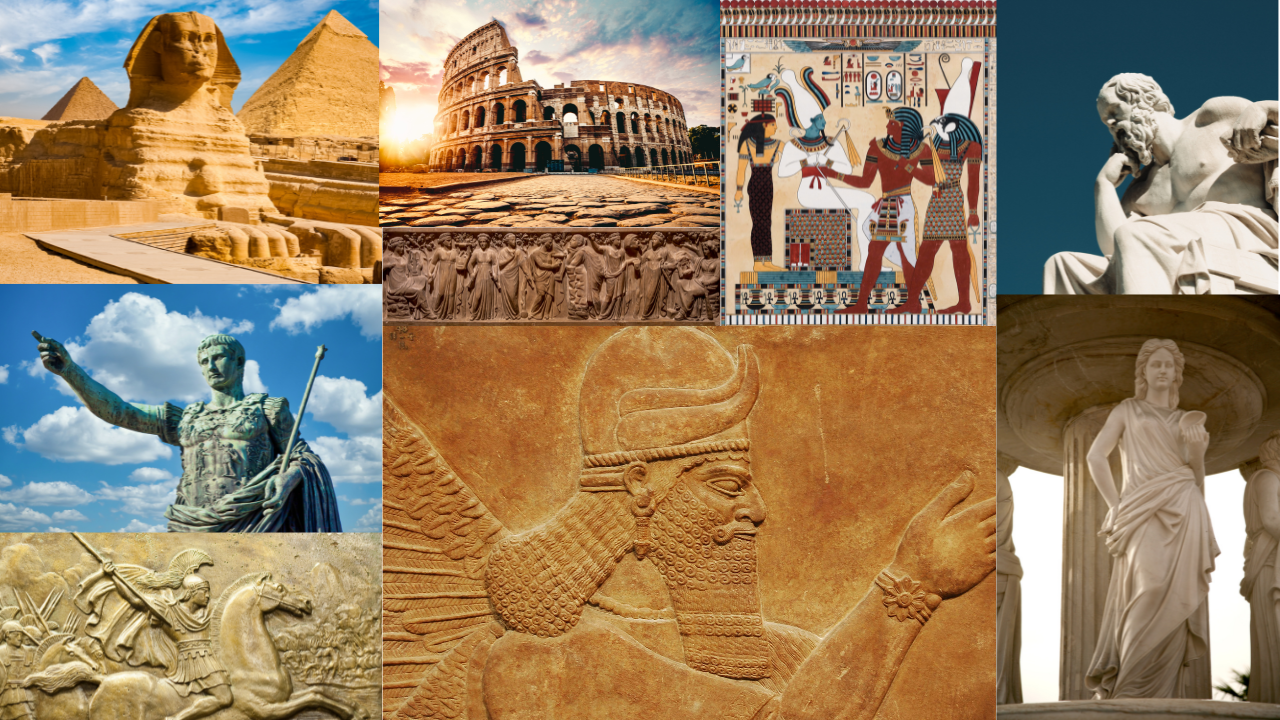
This series is designed to help people better understand the Bible and how it speaks to us. Read the series Introduction post to learn how this series is designed to help you.
We introduced you to the topic of ‘context’ in our last post, but now we want to get a better understanding of how these contexts help us in our Biblical engagement.
Let’s look at how this works.
Why Is Historical / Cultural Context Important?
Historical / Cultural context matters because the events of the Bible actually happened. The people were real people. They lived real lives. God is the architect of reality, and He instructs and convicts people’s hearts in and through their historical setting. Once we become aware of this reality, and we add it to the way we think about and understand the Bible, we are able to extract rich depths of meaning.
We refer to this branch of study as “historical / cultural” because both words draw our attention to slightly different points of interest.
Historical
It is probably safe for you to think of “Historical Context” as a large umbrella term. Here, we are interested in understanding the “historical lay of the land.” What was going on in the world at that time? Who was in power? What were the historical developments that led up to this point in history?
Both the Old and New Testaments have rich historical context, but let’s look at the New Testament for a moment. The events of the New Testament took place in the 1st Century AD (the years “0-99”).1 The setting was the Eastern Mediterranean world. So, what were some of the historical developments that created the circumstances in which our New Testament characters lived?
Much of this region had been controlled by different empires over the previous centuries. The Persians ruled; the Greeks ruled; and the Romans ruled. This amount of transition and foreign influence, especially in Israel / Palestine,2 created unstable circumstances. These circumstances created nuance and texture to people’s lives through culture.
Culture
It is probably safe for you to think of “Culture” as a bit more specific than the broad category of “History”. History affects culture. We see this in our own day. If you travel around the United States, you will notice cultural differences in different regions of the country. Many of these differences are influenced by each region’s history and geography.
The same applies to the people, places, and events of the New Testament. Imagine you are a Jewish follower of Jesus in First Century Israel / Palestine. What are the cultural circumstances in which you live? First, you have your rich Jewish culture that goes back millennia. Second, your part of the world has been HEAVILY influenced by Greek culture because of Alexander the Great’s conquest in the 4th Century BC. Third, you are firmly under the boot of the Roman Empire. All of these circumstances clash, and they create a tumultuous environment.
Now, imagine you get your hands on a copy of 1 Peter, and you get to the part where Peter says to submit to governing authorities and “honor the emperor” (1Peter 2:13-17). First Century Israel / Palestine was occupied by the Romans, and the Jewish people longed for independence and self-governance. How would Peter’s instructions make you feel? These words would have challenged your emotions. You would feel the weight of their impact on you and your circumstances.
Conclusion
Learning more about the historical and cultural circumstances of the people and events of the Bible helps us understand the meaning of the Biblical text to both its writers and original recipients. When we lack this information, we interpret the words, concepts, instructions, descriptions, and meaning of the Biblical text through our cultural circumstances. The problem with this is that the Bible was not written through or to our cultural circumstances (though some overlap between our circumstances and theirs does exist). Thus, a better understanding of the historical / cultural context of the Bible helps us better understand the weight of what the Bible says.
Some Specific Points of Interest When Studying Historical / Cultural Context
- Historical time period
- Geography
- Political rulers
- Religion
- Language
- Cultural Milieu
- Lifestyle
- Technology
Types of Resources Where You Can Find This Information
- Bible Dictionaries
- Bible Encyclopedias
- Bible Atlas
- Bible Commentaries
- Study Bibles
- Google is not a recommended resource because it is difficult to vet the credibility of the sources you find.
Happy Bibleing!
Footnotes
- A brief side-note on dates:
“Century” is a common way to refer to a range of dates. This range always refers to the previous 100 years from whatever century is named. For example: the 3rd Century AD refers to the years 200-299. The birth of Jesus Christ marks the dividing line between BC and AD.
AD Centuries count forward in time from the year “0”, which serves as the transition from BC to AD. Thus, the year 100 AD is farther in the past than the year 1000 AD.
BC Centuries count backward from the year “0”. The 3rd Century BC refers to the years 299-200 BC. The year 299 BC is farther in the past than the year 200 BC. The ancient world did not use this same dating system.
Finally, you might see the terms “BCE” and “CE” (‘Before Common Era’ / ‘Common Era’) instead of BC / AD. The date ranges remain the same. BCE refers to the same dates as BC, and CE refers to the same dates as AD.
↩︎ - Here, “Palestine” does not refer to the modern political entity known as ‘Palestine.’ Scholars often refer to the region that makes up modern Israel & Palestine as “Palestine”. Using this term in the context (see what I did there?) of Biblical studies does not make a modern political statement. ↩︎
Leave a Reply