
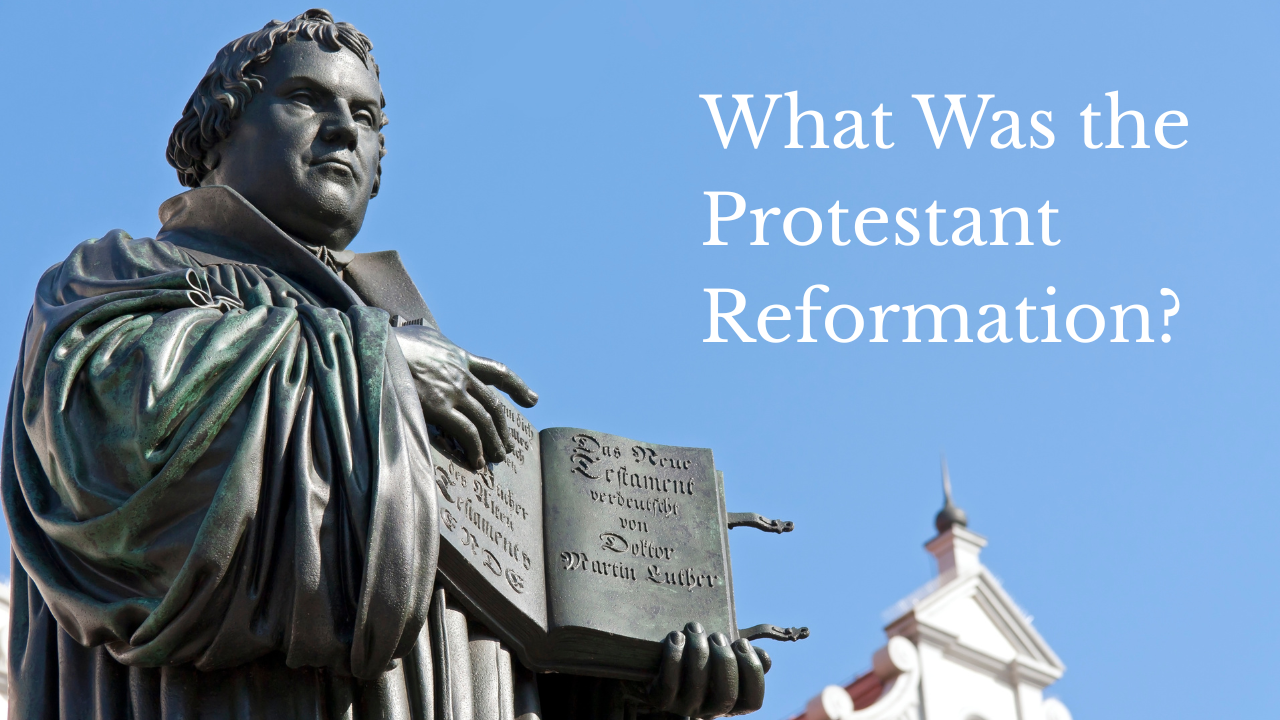
Happy October 31st, or, as it’s less commonly known, ‘Reformation Day’!
Reformation Day is obviously the minority holiday on October 31, but it is valuable to me as a Protestant, and I’d like to highlight what makes the Protestant Reformation special.
THE PROTESTANT REFORMATION IN A NUTSHELL
It is difficult to pinpoint when the Reformation began, but we can see that it was a movement with momentum in the early 16th century. That century saw (among other events):
- Martin Luther nail his 95 theses to the door of Wittenburg Church in 1517
- the Roman Catholic Church’s “Counter Reformation”
- The Roman Catholic Church’s “Council of Trent” (1545–1563)1
THE GOAL OF PROTESTANTISM
This section relies upon Gavin Ortlund’s book What It Means To Be Protestant.2 The goal of Protestantism was not to abolish the Roman Catholic Church. Rather, it sought to reclaim the faith and practice of biblical and ancient Christianity. The Reformers pursued this with 3 overarching principles:
SOLA SCRIPTURA (“Scripture Alone”)
Sola Scriptura means that Scripture alone is the final authority for determining faith and practice. This means the tenets of the faith are ultimately defined by Scripture, and the practice of those tenets– the way we embody and live out our faith– are evaluated against Scripture alone.
This does NOT mean “Scripture only.” Protestants do not reject or dismiss church tradition– at least those who properly practice Protestantism do not! Everyone, Protestants included, has a church tradition. The Protestant aim is to evaluate that tradition against Scripture and then adjust the tradition when Scripture confronts it. As a Protestant, it is inappropriate to see church tradition as having the authority to evaluate Scripture. Scripture alone is the only infallible source for faith and practice.3
SOLA FIDE (“Faith Alone”)
Sola Fide affirms that salvation is by faith alone. A major motivation for the Reformation was the abuse of indulgences. The Roman Catholic teaching on salvation is that initial justification is by faith, but final justification is attained by individuals co-operating with the Holy Spirit through and because of faith to produce works of faith that merit eternal life.4
The practice of indulgences in the Middle Ages was a means for individuals to purchase merit and thus decrease the amount of time they would spend in Purgatory.
Protestantism denies the meritorious nature of good works toward’s an individual’s sanctification. Instead, the Protestant tenet of Sola Fide affirms that works are the result of a genuine faith, and it is through faith alone that God brings that individual through the sanctification process.
SEMPER REFORMANDA (“Always Reforming”)
The Reformers recognized the need for error correction, so they sought to be an “always-reforming church.” When evaluating Roman Catholic tradition against the teachings of Scripture and the writers in the early church, the Reformers noticed inconsistencies and additions to what their ancient Christians brothers and sisters believed and practiced. This led them to recognize the necessity to not only evaluate tradition but to do so with the humility to admit when deviations and errors have occurred.
Conclusion
Historical Protestantism did not seek to start something new.5 Instead, the Reformers sought to recover the ancient faith that was practiced by the early church. Protestantism is not perfect, but it also never claimed to be. It seeks to pursue and practice faith in Jesus in accordance with the Scriptures and to always remain humble enough to correct errors when they emerge.
Happy Bibleing and Happy Reformation Day!
Footnotes
- Steven Wedgeworth, “What Is the Protestant Reformation? Everything You Need to Know,” Logos Grow, October 27, 2025, https://www.logos.com/grow/protestant-reformation/?utm_source=logos_desktopapp&utm_medium=rss_blog. ↩︎
- Gavin Ortlund, What It Means To Be Protestant: The Case for an Always-Reforming Church, (Grand Rapids: Zondervan, 2024). ↩︎
- Gavin Ortlund, What It Means To Be Protestant, 11–14. ↩︎
- Catholic Church, Catechism of the Catholic Church, 2nd Ed. (Vatican City: Libreria Editrice Vaticana, 1997), 481–87, particularly paragraphs 1987–95, 2006–2010. ↩︎
- Gavin Ortlund, What It Means To Be Protestant, 3–14, 135–58. ↩︎
Leave a Reply