
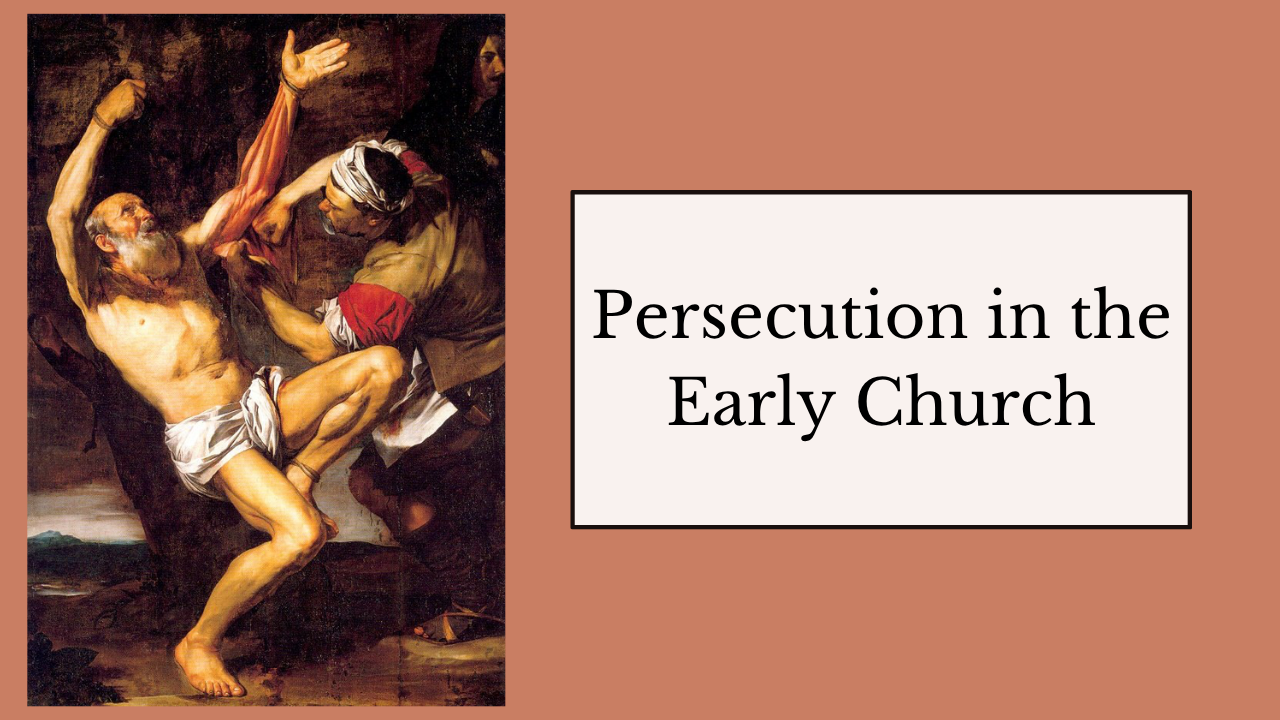
Introduction
Persecution was common from the time of Jesus into the early church. For convenience, I will discuss the pre-Imperial church1 The Imperial Church began when Constantine legalized Christianity and Roman politics became involved in the Church. in three phases: the Messianic following, the Apostolic Church, and the Post-Apostolic Church.2 The Church did not technically begin until Pentecost, which was after the death, resurrection, and ascension of Jesus. Persecution occurred in all three phases, but the persecutors develop and expand in each era.
One thing to keep in mind is that the persecutors of the early church were not always the same as those who inflicted the punishment. Therefore, it will be helpful to distinguish between:
- active persecutors – those who actively worked against the Church towards its demise;
- agents of punishment – those who inflicted the punishment on behalf of the active persecutors.
The relationship between the active persecutors and the agents of punishment is interesting. There are situations where the two groups are distinct from one another (Jesus’ crucifixion), but there are also times when the two groups are the same (Paul being stoned at Lystra). When the two were different, the agent of punishment was usually Rome. Eventually, however, Rome also became the active persecutors.
Persecution in the Various Eras of the Early Church
The Messianic Following
The Messianic Following refers to Jesus’ public ministry and His followers. Jesus was targeted by the Jewish religious leaders and put to death by Rome. The Jewish leaders did not put Jesus to death themselves. Instead, they forced the Roman governor’s hand to do it for them (cf. Matt. 20:18; 27:1–2).
The followers of Jesus were also vulnerable to this persecution, but none of them were put to death at this time (cf. Matt. 26:69–75; John 19:16–19).
In the Messianic Following, the active persecutors were the Jewish religious leaders, and the agent who acted on their behalf was Rome.
The Apostolic Church
The Apostolic Church refers to the church during the lifetime of the Apostles. This era ended with the death of the Apostle John in the final years of the first century. In total, the era of the Apostolic Church spanned from circa AD 33–100.
Most of the persecution during this time was from individual groups of people who resisted the Church. Some of them appealed to the governing authorities to intervene against the Church:
- Peter and John were arrested by the temple officials and Sadducees (Acts 4:1–3)
- The high priest arrested and beat the Apostles (Acts 5:17–18; 40–42)
- Stephen was stoned (Acts 7:54–60)
- Saul persecuted the Church on behalf of the Jewish religious leaders (Acts 8:1–3; 9:1–2)
- Paul and Barnabas faced hostility from some Jews throughout their missionary journeys (Acts 13:44–45; 49–50)
- The Jews at Iconium followed Paul and Barnabas from Iconium to Lystra to stone them (Acts 14:1–2, 5–6, 19)
- Paul and those with him were thrown into jail because of a disgruntled family (Acts 16:16–24)
- The Jews at Thessalonica rioted and followed Paul to Berea (Acts 17:4–8, 10, 13).
- Demetrius started a riot at Ephesus against Paul. The riot was so great that the city officials needed to intervene (Acts 19:23–41)
Some political leaders also persecuted the Church:
- Herod killed members of the Church (Acts 12:1–3)
- Emperor Nero blamed and murdered Christians for the fire that devastated Rome in AD 64. It is unlikely that Christians were responsible for the fire, so Nero’s actions against them were opportunistic rather than systematically organized. It is also believed that the Apostles Peter and Paul were executed by Nero at this time.3 Edwards, Jordon H. “Nero Claudius.” In The Essential Lexham Dictionary of Church History, edited by Michael A. G. Haykin. Bellingham, WA: Lexham Press, 2022. Potter, D. S. “Persecution of the Early Church.” In The Anchor Yale Bible Dictionary, edited by David Noel Freedman. New York: Doubleday, 1992. Elwell, Walter A., and Barry J. Beitzel. “Caesars, The.” In Baker Encyclopedia of the Bible, 1:392–97. Grand Rapids, MI: Baker Book House, 1988.
- Emperor Domitian (AD 81–96) also persecuted both Jews and Christians. It is possible Domitian’s attention was primarily focused against the Jews after the destruction of the Jewish temple in AD 70, and Christians were seen as a sect of Judaism.4 Justo L. González, The Story of Christianity, vol. 1, The Early Church To The Dawn Of The Reformation, rev. ed. (New York: Harper One, 2010), 46–48.
The active persecutors during the Apostolic Church were individuals and Jewish religious leaders who resisted the faith and practice of the Christians for one reason or another. The agents of persecution were often times the same as the active persecutors (the Jews in Iconium, Demetrius in Ephesus). Although government officials got involved, even as high ranking as the Roman Emperor, there is no evidence to suggest the presence of an organized and widespread persecution against the Church during the Apostolic era.5 González, The Story of Christianity, 41–48.
Thus, Roman and civil authorities became agents of punishment when the active persecutors escalated the situation to the point of intervention. The two Roman emperors (Nero and Domitian) inflicted persecution were unique. They capitalized on opportunities for persecution, and they happened to have the might of the Roman government behind them.
The Post-Apostolic Church
The Post-Apostolic Church refers to the church after the death of the last Apostle (John, circa AD 100) and goes until the beginning of the Imperial Church – when Christianity became a legal religion within the Roman Empire in AD 313.
It is within this era of the church that Rome conducted a formal and widespread persecution of Christians.
Rome’s formal persecution of Christians began in Bithynia under the local governor, Pliny the Younger, in AD 111. Upon becoming governor of Bithynia, Pliny discovered that the local practice of Greco-Roman paganism had all but disappeared. He learned the reason for this was the large number of Christians in the area.
By this time, Christianity was viewed by Rome as distinct from Judaism and was therefore illegal. Pliny interrogated Christians within his region and gave them an ultimatum: they could recant their faith by (1) praying to the gods, (2) offering incense to the image of the emperor, and (3) cursing Christ. Pliny gave accused Christians three opportunities to recant. If they refused, they were executed.6 González, The Story of Christianity, 49–50.
Pliny wanted further clarity on how to proceed against the illegal Christians, so he wrote a letter to Emperor Trajan requesting guidance. Trajan responded by saying Christianity was indeed illegal, and Pliny was right for taking legal action. However, Trajan instructed Pliny to refrain from seeking out Christians. Should someone be accused of being a Christian, then Pliny was to followup with his ultimatum. Otherwise, taking the initiative to seek Christians out was a waste of time.
Thus, Rome’s official policy was this: it was illegal to be a Christian, but Rome would only pursue and interrogate individuals who were accused of being Christians.
In the Post-Apostolic era of the Church, the active persecutors finally moved up the authoritative ladder to the Roman Empire itself – albeit with some caveats. The agents of persecution were also Rome. For the first time, Christians had the formal and legal eye of Rome looking at them. It was not an inquisition, but to be Christian was to be on the wrong side of Roman law.
Correspondence Between Pliny the Younger and Emperor Trajan Regarding Christians
It is my regular custom, my lord, to refer to you all questions which cause me doubt… I have never attended hearings concerning Christians, so I am unaware what is usually punished or investigated, and to to what extent… In the meantime, this is the procedure I have followed, in the cases of those brought before me as Christians. I asked them whether they were Christians. If they admitted it, I asked them a second and a third time, threatening them with execution.
Pliny to Trajan7 Pliny the Younger, Complete Letters, OWC, trans. P.G. Walsh (Oxford: Oxford University Press, 2006), 278, Letter 96, https://research-ebsco-com.cornerstone.idm.oclc.org/c/6r26ad/search/details/g47qm7eejr?request-context=plink&db=e000xna.
You have followed the appropriate procedure, my Secundus, in examining the cases of those brought before you as Christians, for no general rule can be laid down which would establish a definite routine. Christians are not to be sought out. If brought before you and found guilty, they must be punished, but in such a way that a person who denies that he is a Christian and demonstrates this by his action, that is, by worshipping our gods, may obtain pardon for repentance, even if his previous record is suspect.
Trajan to Pliny8 Pliny the Younger, Complete Letters, OWC, trans. P.G. Walsh (Oxford: Oxford University Press, 2006), 279, Letter 97, https://research-ebsco-com.cornerstone.idm.oclc.org/c/6r26ad/search/details/g47qm7eejr?request-context=plink&db=e000xna.
Works Cited
- Elwell, Walter A., and Barry J. Beitzel. Baker Encyclopedia of the Bible. Grand Rapids, MI: Baker Book House, 1988.
- Freedman, David Noel, Gary A. Herion, David F. Graf, John David Pleins, and Astrid B. Beck, eds. The Anchor Yale Bible Dictionary. New York: Doubleday, 1992.
- González, Justo L. The Story of Christianity. Vol. 1, The Early Church To The Dawn Of The Reformation. Rev. ed. New York: Harper Collins, 2010.
- Haykin, Michael A. G., ed. The Essential Lexham Dictionary of Church History. Bellingham, WA: Lexham Press, 2022.
- Pliny the Younger. Complete Letters. OUP Oxford, 2006. EBSCOhost.
Leave a Reply