
This series is designed to help people better understand the Bible and how it speaks to us. Read the series Introduction post to learn how this series is designed to help you.
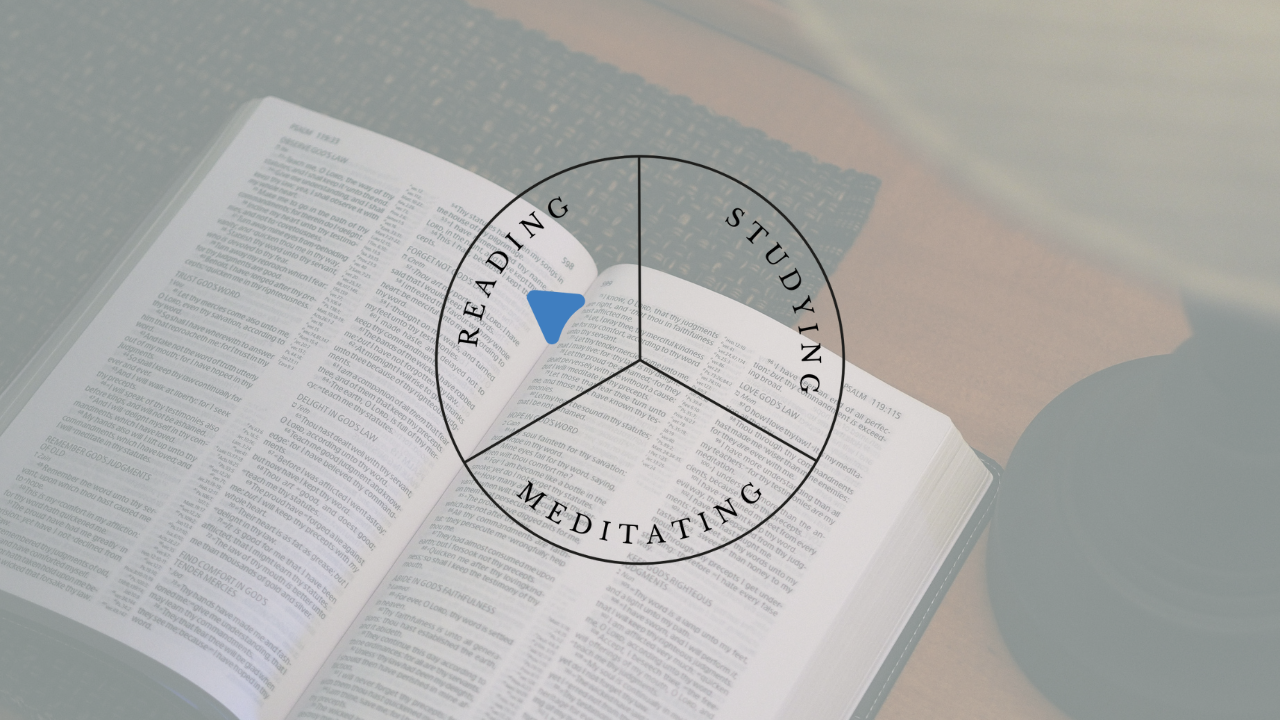
At this point in the series we are covering Biblical Engagement: how we actually sit down and grow from the Bible. The previous post introduced the concept of a three-fold, complementary approach to engaging with the Bible. This post discusses the first of those engagement methods: Reading
Definition, Purpose, & Process
I define reading as the “Consistent Absorption of the Text.”
The purpose of reading is “to build familiarity with the text by covering ground in the text.”
The process of reading is as follows:
- Just you and the text (no outside sources, including study Bible notes)
- Set the scope of reading (whole Bible, prophetic books, the Gospels, Epistles, etc.)
- Consistently read in uninterrupted “chunks”(we recommend at least 4 chapters at a time)
- Have a system of documenting your observations and questions — this can be a notebook, google doc, etc.
- Don’t investigate your questions right away. Continue in the flow of reading. Then, set a time to come back and investigate any questions.
Don’t overthink Reading. It really is as simple as it sounds… you just read the text. Reading doesn’t feel like magic because God hasn’t revealed Himself through magic, nor does He work in our lives through magic. What He does is way better than that: He works within us in real time through incremental growth. Reading is a great example of this.
Reading is NOT
- the time to pursue rabbit trails
- constantly looking at commentaries or Study Bible notes
- the time to investigate the questions / observations you notice
These aren’t bad things. They just aren’t the purpose of Reading. Reading allows us to see the bigger, broader picture of the Bible, so that is what we want to emphasize when Reading. We will pursue these other things when Studying.
The Value of Reading
Reading is valuable because it increases our familiarity with the text as well as its main character, God. Greater familiarity with the text enables us better understand the Bible in general in multiple ways:
Cohesion: Reading makes the Bible feel smaller, thus reducing the ‘intimidation factor’. It also allows us to experience the cohesive unity of all the different books of the Bible.
Meta Narrative: Reading helps us focus on the overarching story of the Bible. What story does God tell through His Word, and how do the individual books contribute to it?
Repetition and Themes: Reading exposes you to a greater percentage of the Bible in a compressed amount of time. This allows you to notice repetition and themes you would otherwise miss.
Getting a better handle on these allows us to gain traction with the Biblical text, which helps us better understand the message and meaning of the tex, which enables us to grow in our faith.
The Practice of Reading
So, how do you start reading and progress at it? Let’s look at how you could do this through the Gospels. One way is to repeatedly read one of the Gospels over a period of time. For example, you could read the book of Matthew 4 times in a month. That would be 4 chapters a day, 7 days a week for 4 weeks.
Another option would be to read all 4 Gospels 3 times in just over 2 months. At 4 chapters a day, this would take you 9 weeks. This would help you build familiarity with each gospel, and develop your ability to notice similarities and differences between them.
A third option would be to read the entire New Testament. This would take 65 days (again, just over 2 months) at 4 chapters a day. Reading this way would expose you to material you may never have encountered before, and let you see the overarching story of the entire New Testament. You would also notice repetition of words and themes.
A fourth option would be to read the entire Bible in 1 year, 6 months, 90 days, or 30 days. This approach allows you to experience the meta narrative and feel its cohesion in ways that are otherwise inaccessible to you. Again, you would very much notice repetition.
There are many more options you could do. Regardless of which one you try, the objective remains the same: build familiarity with the text by covering ground in the text. Feeling lost in the narrative of the Pentateuch (Genesis – Deuteronomy)? Read it in 7 weeks. That would be 4 chapters a day with a few catch up days built in.
Reading isn’t about making sure you catch absolutely everything that could possibly ever be significant in the text before you close your Bible for the day. That’s the pressure people often place on their Bibleing experience. But that’s not the purpose of Reading — nor is it the purpose of my approach to Biblical Engagement at all.
Reading IS about building a foundation of familiarity of the Biblical story through the incremental growth of consistently absorbing the text in a compressed amount of time. You won’t notice EVERYTHING the 1st time you read a story; or the 2nd time; or the 5th, the 10th, the 50th, or 100th. But you WILL notice more each time you absorb that story.
A Testimony About Reading
I want you to know that I have discovered the power of Reading first hand. I used to be functionally illiterate. I went to college not being able to comprehend anything I read. I didn’t understand grammar, and I didn’t know how language functioned. But I realized my options were to either learn how to read or flunk out of college. I committed to getting better at reading just to survive my college history classes. That commitment carried over to my Bible reading. When I switched to a Biblical Studies major, the Bible became my main text book. My homework was to read the Bible, but I also began reading it during my personal time. One thing I have noticed: I have never studied parts of the Bible that I didn’t read first. Reading builds familiarity with the text, and that familiarity serves as a launchpad into Studying. The observations we make while Reading become the topics we focus on in our Study.
Conclusion
Reading is simple, but it works. You can and will get better at it, so don’t be concerned about starting as a below average reader. I couldn’t read at all when I started! I encourage you to commit to it, because I believe you will be blown away by your experience.
Happy Bibleing!
Leave a Reply