
This is an interesting question. The answer is both yes and no and the same time.
Let me explain.
I am far more familiar with Greek than I am with Hebrew, so that will be the language I focus on.
How Language Shapes Biblical Thought
There is a definite upside to reading and studying the New Testament in Greek. First, Greek is the language of New Testament thought. We think in our language before we speak or write in it. English is my native language, which means I think in English. Concepts are formed in my mind using an English framework. You may not realize it, but languages think about the same concept differently.
Look at how English and Spanish think of a person’s age:
English: How old are you?
Spanish: ¿Cuántos años tienes? (How many years do you have?)
In English, age is something that is inseparable from the individual; you actually are that age. In Spanish, however, age is something the individual acquires, as if it is added to the individual.
So, when it comes to the Bible, there is great value in being able to read the words the biblical writers thought in. Over time, you are able to develop a feel for how Greek thinkers thought through concepts.
What Gets Lost In Translation
Second, it is true that some things get lost in translation. There aren’t universal grammar rules that every language follows. The rules that one language follows might not exist in another language. This is what makes translation difficult.
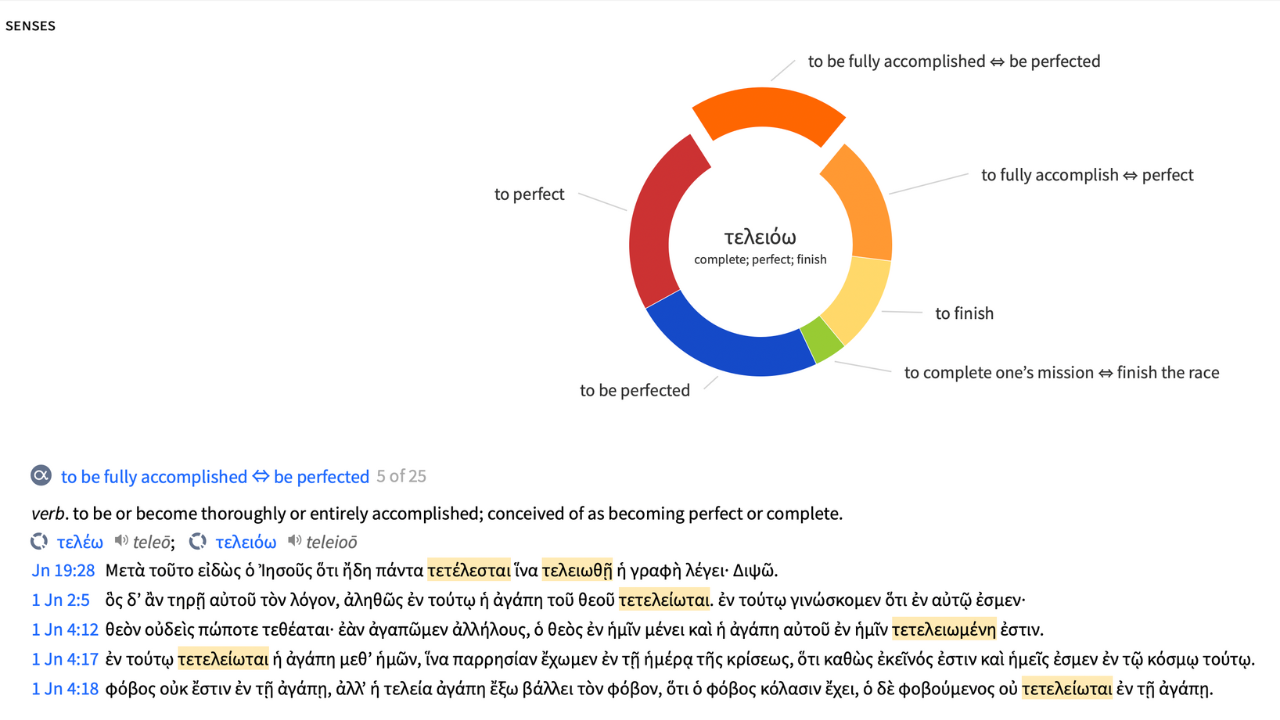
Perhaps the best example of this between biblical Greek and modern English is the relationship between between two or more nouns. Greek nouns can have 30+ interpretive options. We determine which option is preferred based on the context of the passage. It is the nuance of these relationships that get lost in translation. An example of this is 1 John 2:5a, which says but whoever keeps his word, in him truly the love of God is perfected (ESV). The phrase in question is the love of God. The structure of this phrase could allow for either of the following readings:
- An individual’s love for God
- God’s love that develops within the individual
Which is it? By using the English word “of,” the ESV leaves it intentionally ambiguous and up to the reader. The NIV makes the decision for the reader: but if anyone obeys his word, the love for God is truly made complete in them. Knowing Greek will equip you to wrestle with these interpretive questions (and these questions are important because they frame our doctrines!). However, it will take multiple years of rigorous study to get to that stage.
At the end of the day, knowing Greek and Hebrew will enrich your Bible Study, but you’ll find yourself asking 5–10 questions for every question you answer.
Can’t I Just Look Up Greek and Hebrew Words Without Having To Learn The Language?
Yes… but I advise extreme caution.
A word’s definition is only part of how that word communicates meaning. Again, let’s look at Greek. First, a Greek noun has a range of possible definitions (referred to as semantic range). Which definition is correct? Well, that depends on how the noun is used in the sentence – particularly how it relates to the other words around it. Greek has a sophisticated sentence structure. A change in the sentence structure can change the meaning of a word.
Let’s look at 1 John 2:5 again. This won’t be the most theologically significant example, but it will illustrate how definitions alone might lead you in the wrong direction. There is one phrase that is repeated in this verse: ἐν τούτῳ (en toutō). The first word (ἐν) is a preposition, often meaning in. The second word (τούτῳ) is a demonstrative pronoun, often meaning this. Here’s how the verse looks if we replace the English translation with the Greek phrase: “but whoever keeps his word, ἐν τούτῳ (en toutō) truly the love of God is perfected. ἐν τούτῳ (en toutō) we may know that we are in him.”
Looking at the definitions of ἐν τούτῳ (en toutō), we would expect the verse to read “but whoever keeps his word, in this truly the love of God is perfected. In this we may know that we are in him.” So…. why doesn’t the ESV (or anyone) translate it that way?
It is because the demonstrative pronoun τούτῳ (toutō) is commonly used instead of the personal pronoun he. This is very common in the New Testament. In fact, John often refers to Jesus as that one. The beginning of 1 John 2:5 indicates John is talking generically about the one who does such-and-such. Therefore, when we reach the first use of ἐν τούτῳ (en toutō), we can recognize that John is using this phrase to point back to the generic person (the one who does such-and-such) mentioned at the beginning of the verse. However, in the second occurrence of ἐν τούτῳ (en toutō), John uses the phrase to point back to the idea that the love of God is perfected. Thus, he uses the phrase two different ways in as many occurrences.
It may not be impossible, but my experience with Greek tells me that it is very difficult for someone who has never studied Greek to correctly understand how John uses ἐν τούτῳ (en toutō) in 1 John 2:5 if they are only looking at definitions.
Like I said, our 1 John 2:5 example is not the most theologically weighty example in the New Testament. But it does illustrate how someone’s reasonable inference from a definition alone could lead them away from what the biblical writer actually meant.
All this to say, be very careful and cautious when conducting word studies. These were real words with real meanings in the ancient world. They don’t only mean what we think they mean in the Bible. If we aren’t careful, we will proclaim that God’s Word says (and means!) something that it’s not actually saying.
Can You Study the Bible well without learning Greek and Hebrew?
I am a firm believer that Greek and Hebrew are not required for Bible Study. God’s word is living and active; we hear from God when we engage His word — even a translation of it. Learning Greek has increased my confidence in our English translations. Getting into God’s word with a humble and faithful heart that desires more of Him is the important thing. Pay attention to what the biblical writers say and how they say it. Read and study in multiple translations. If you want to understand the Greek or Hebrew behind an English word, find a trusted source — someone who has expertise in Greek and Hebrew.
Happy Bibleing!


Leave a Reply