
A Quick Note To The Reader
Our Absolute Beginner Bible Studies are designed for people who want to grow from the Bible but don’t know how or where to begin. You do not need any of the following:
- Be familiar with your Bible
- Be a good reader
- Be familiar with Christian theology
- Have a set of Bible study tools at your disposal
- Have studied anything in the Bible before
We remember how we struggled through the Bible when we began reading and studying it, so we want to help anyone who finds themselves at the very beginning.
You can read more about the structure and purpose of these studies here.
The Roadmap
We will follow the section headings of the Christian Standard Bible (CSB).
There are four sections in chapter 1:
- Greeting (1:1–2)
- God’s Rich Blessings (1:3–14)
- Prayer For Spiritual Insight (1:15–19)
- God’s Power In Christ (1:20–23)
We will identify the big ideas in each of these sections, and then we will look at those big ideas at the end.
It might be helpful to have your Bible open as you read this post.
Side note / helpful tip: You will notice Scripture references in parentheses with the letters “cf.” preceding the reference. The book of the Bible is often abbreviated. The letters “cf.” mean compare / confer with. It tells the reader that the writer has those verses in mind while making his / her point. Here is an example: “God created the earth (cf. Gen. 1:1).”
Greeting (1:1–2)
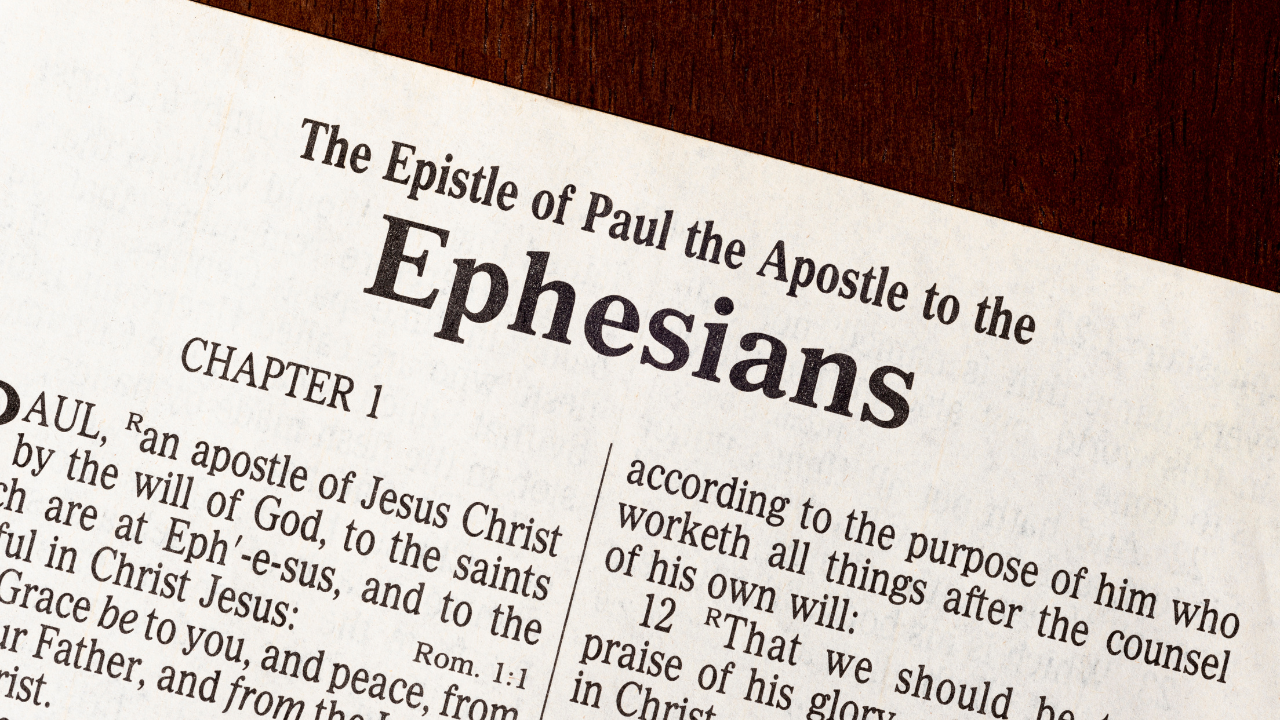
Verse 1 identifies the writer of this letter as “Paul.” Paul describes himself as “an apostle of Christ Jesus.” We won’t do many word studies at this stage of Bible Study, but we do need to understand the term “apostle.”
The word “apostle” comes from the Greek word apostolos. It referred to someone who was sent by someone else on their behalf. The apostle (the sent one) was the sender’s representative, and the apostle would have the authority of the one who sent them. This is very similar to an ambassador today.
In the early church, certain individuals were set apart as apostles. These included 11 of Jesus’ 12 disciples, Matthias, and Paul — the same Paul that we have here in Ephesians. In order to be set apart as an apostle in the early church, the person had to have experienced the resurrected Jesus. After Jesus died, He was buried. After being in the tomb 3 days, He rose again from the dead. After rising from the dead, He walked on earth for 40 days. After the 40 days, He ascended into heaven. To be an apostle, you had to have had an experience with Jesus after He rose from the dead. For Paul, this experience happened while he was traveling along the road to Damascus. You can read about that experience in Acts chapter 9.1
So, returning to Ephesians 1:1, we see the letter is written by Paul, who is “an apostle of Christ Jesus.” This means he is set apart for a distinct role within the early church. His role is authoritative. We also see that his appointment to the role of apostle was “by the will of God.”
You’ll also notice that it is written “Christ Jesus” instead of “Jesus Christ.” That is because “Christ” is not Jesus’ last name. It is actually a term that describes Jesus’ identity within God’s plan to redeem the world. The term “Christ” is a Greek version of the Hebrew word “Messiah.” Both words mean “anointed one” and/or “chosen one.”
Next, we see that Paul is writing “to the faithful saints in Christ Jesus at Ephesus.” This is Paul’s way of saying “to those who believe in Jesus and live according to His teachings in Ephesus.” The book of Ephesians, then, is a letter from the Apostle Paul to the Ephesian Church.
God’s Rich Blessings (1:3–14)
This is a difficult passage because Paul wrote it as one, giant, run-on sentence. The CSB (along with other English translations) have broken it into multiple sentences and paragraphs so that readers can understand it more easily. For our purposes, we want to avoid feeling “lost.” In this post, then, we will identify the key items and ideas. This will give you a foundation that you can build upon each time you read and re-read this passage.
Here we go!
Verse 3 is the big idea for this entire passage. It says “Blessed is the God and Father of our Lord Jesus Christ, who has blessed us with every spiritual blessing in the heavens in Christ.” This sentence is the topic that Paul wants to talk about. It is called a ‘thesis statement.’ A thesis statement represents what you believe to be true. It is the thing your are making your case about. It is the thing you want everyone else to embrace. It is the statement that you plan to support and defend with the rest of your content.
So, for this section, Paul asserts that The God and Father of our Lord Jesus Christ is blessed because He has blessed us with every spiritual blessing in the heavens in Christ (my paraphrase). Everything else in verses 4–14 explain why verse 3 is true.
The reasons why Paul says God is blessed are as follows:
- He chose us in Him [Christ]
- He predestined us as adopted sons through Christ
- He lavishes His good will upon us
- We have redemption through Christ
- He poured out is grace upon us in wisdom and understanding
- He made known to us the mystery of His will
- He is uniting all things together in Christ
- We have received an inheritance in Christ
- Our hope in Christ glorifies God
- Those who believe in Jesus Christ are sealed with the Holy Spirit, Who God promised to send to His people
- The Holy Spirit is the downpayment for our salvation
These are the topics that Paul discusses in verses 1:4–14, and they all reinforce why verse 3 is true.
So, Ephesians 1:3–14 tells us that God is big, powerful, has a plan, is working to implement that plan, and that we are part of His plan because of His love for us and His grace.
Bless God indeed!
Prayer For Spiritual Insight (1:15–19)
This section is Paul’s prayer for the Ephesians. The big idea is traced through two verses. First, Paul wants to communicate that he never stops giving thanks in his prayers for the Ephesians (verse 16). Second, Paul indicates why he never stops giving thanks. The phrase “This is why” in verse 15 indicates a link to everything Paul just said in verses 3–14.
So, the idea that God is blessed and all the supporting evidence he just cited is why Paul does not cease giving thanks for the Ephesians. He rejoices in the fact that they believe in Jesus and are counted among the people of God.
Verses 17–19 are the content of Paul’s prayer. He prays:
- That God would give them the Spirit of wisdom and revelation in the knowledge of Him
- That their hearts would be enlightened
- That they would know the hope of God’s calling on their lives
- That they would understand the full measure of the inheritance that comes with being among God’s people
- That they would understand the greatness of God and His power
So, in light of the truths that were laid out in verses 1:3–14, Paul is praying that the things in verses 17–19 develop within the Ephesians.
God’s Power In Christ (1:20–23)
This section builds upon the previous one. In verse 20, Paul says “He exercised this power.” The presence of “this” indicates he is referring to what he just said in verse 19 — “and what is the immeasurable greatness of his power toward us who believe, according to the mighty working of his strength.”
Now move to verse 20 — “He exercised this power in Christ by raising him from the dead and seating him at his right hand in the heavens.”
God’s great power is evidenced by raising Christ from the dead and seating Him at His right hand. The resurrection of Jesus Christ is the evidence of God’s great power to overcome death. It is the evidence that God is capable of restoring all things. His plan is to bring about this restoration through Jesus Christ (cf. Ephesians 1:9–10).
The resurrection of Jesus and the act of placing Him at God’s right hand in the heavens means Jesus is over all things. Verse 22 says everything is subjected to Jesus, and look at Paul’s previous description of Jesus’ position in verse 21. Jesus is above:
- Every ruler
- Every authority
- Every power
- Every dominion
- Every title
- For all time and all places
The resurrection of Jesus and God’s elevation of Jesus above all things is the display of God’s great power that Paul addresses in verses 1:19–20.
Concluding Thoughts
That’s the first Chapter of Ephesians!
It is a marvelous book that I fall more in love with every time I study it. I hope that is your experience too.
Here are some takeaways from today’s study:
- God appointed individuals (apostles) to proclaim His message to the earth. We are indebted to them for their teaching because it is through them that God speaks to the world.
- God is worthy to be blessed because of who He is, what He’s done, what He is doing, and what He will do. This means that we take time to reflect on God’s redemptive work. We thank and praise Him for His plan of redemption, and we thank Him for offering redemption to us through grace. God moves towards us out of love and grace.
- Not only has God redeemed us, but He has lavished His love, joy, grace, and splendor upon us. He could have simply no longer declared us guilty of sin, but He did far more than that. He adopted us and gave us a rich inheritance. Bless Him indeed!
- Knowing what God has done for us should spur us to want to know Him more deeply. We should adopt Paul’s prayer for the Ephesians for ourselves, so that we too can know and experience God in a deeper way.
- We don’t have to hope that God can do what He’s promised. We know He can because of the fact that Jesus was resurrected from the dead and is seated at God’s right hand.
- Finally, God has given us fellowship with Himself through the Holy Spirit when we place our faith in Jesus. This fellowship is the downpayment of our inheritance, and it further evidences that Jesus is who the Apostles proclaimed Him to be.
Continue to read Ephesians on your own, and stay tuned for our upcoming post on chapter 2!
Don’t get discouraged if you don’t understand something. Just continue to read and re-read Ephesians with a humble heart and curious eyes. God will awaken your eyes to see what is there.
Until next time,
Happy Bibleing!
Watch our Ephesians 1 Absolute Beginner Bible Study here!
Footnotes
- The Paul of Ephesians was formerly known as “Saul.” In Acts 9, he is still referred to as “Saul,” but it is the same person. ↩︎
Leave a Reply to Salvation By Grace And Life In Christ: Ephesians 2 For Absolute BeginnersCancel reply