
This is our Absolute Beginner Bible Study for Ephesians 5.
Introduction
As we did for chapters 1–4, we will follow the section headings in the Christian Standard Bible (CSB). They are as follows:
- Living The New Life (4:17–5:5)
- Light Verses. Darkness (5:6–14)
- Consistency In The Christian Life (5:15–21)
- Wives And Husbands (5:22–33)
Chapter At A Glance
Chapter 5 continues the themes Paul began discussing in chapter 4. He continues the explanation of Christian “do’s and don’ts.” He offers a theological rationale for why these instructions are necessary for God’s household, and then he continues the conduct-based instructions. Christian conduct is supposed to reflect God’s wisdom and presence within His people. Thus, Christians are to live very intentional lives, seeking the wisdom and presence of God in every aspect of their lives.
SIDE NOTE
A verse citation that includes a letter at the end of the final verse indicates the author is only referring to that part of the verse. The letters refer to the number of clauses / concepts within the verse. The more complexity within the verse, the deeper into the alphabet one could go. Here is a simple example from Ephesians 1:1:
Paul, an apostle of Christ Jesus by God’s will (1:1a)
To the faithful saints in Christ Jesus at Ephesus (1:1b)
Living The New Life (4:17–5:5)
5:1 Therefore, be imitators of God, as dearly loved children, 2 and walk in love, as Christ also loved us and gave himself for us, a sacrificial and fragrant offering to God. 3 But sexual immorality and any impurity or greed should not even be heard of among you, as is proper for saints. 4 Obscene and foolish talking or crude joking are not suitable, but rather giving thanks. 5 For know and recognize this: Every sexually immoral or impure or greedy person, who is an idolater, does not have an inheritance in the kingdom of Christ and of God.
Ephesians 5:1–5 (CSB)
This is the first chapter break in Ephesians that does not also begin a new section. This illustrates an important concept and skill set within understanding the Bible: the chapter and verse breaks were added centuries after the New Testament was finished; the chapter & verse breaks are a good-faith effort to match the biblical writer’s intended flow of thought, but they do not dictate the biblical writer’s flow of thought. We need to allow the words themselves and their relationships to one another to dictate the writer’s flow of thought. As you engage with Scripture, do not automatically insert a “concept-break” at the beginning of a new verse, paragraph, or chapter. Instead, allow the writer to lead you through his natural flow of thought. To do this, you want to notice verse and chapter breaks, but you do not want to depend on those breaks for understanding.
Since this section spans two chapters, we need to trace Paul’s logic from Eph. 4:17–5:1.
Remember, the overarching topic within this section is You should not longer walk as the Gentiles do, in the futility of their thoughts (Eph. 4:17). In order to emphasize the urgency for this command, Paul reiterates the contrast between those in Christ and those outside of Christ (whom he is now referring to as “Gentiles;” vv.4:18–24). Then, he explains appropriate vs. inappropriate conduct– remember, this conduct is to be in response to what God has done for us (cf. Eph. 1–3). Thus, we arrive at chapter 5.
Chapter 5 begins with another “therefore” statement: Therefore, be imitators of God, as dearly loved children, and walk in love (Eph. 5:1–2a). The Therefore clearly indicates what he is about to say is in response to what he just previously said. Verses 5:1–2, do two things. First, they provide an identity-contrast to the “Gentiles” of Eph. 4:17. Second, they provide the goal of putting on the new self (Eph. 4:24). New life in Christ means we live as imitators of God, as dearly loved children, and walk in love (Eph. 5:1–2a).
The degree to which we live the new life in Christ is in accordance with Christ’s love for us: and walk in love, as Christ also loved us and gave himself for us, a sacrificial fragrant offering to God (Eph. 5:2). Paul adds to the inappropriate vs. appropriate Christian conduct lists in verses 3–4. Then, he makes this strong statement: For know and recognize this: Every sexually immoral or impure or greedy person, who is an idolater, does not have an inheritance in the kingdom of Christ and of God (Eph. 5:5). Paul obviously knows Christians have the potential & opportunity to be sexually immoral, greedy, and crude because of the fact that he instructs the Ephesians to avoid such things. Christians are not yanked from the household of God if they fall under temptation and commit one of these sins. However, Paul is teaching that these vices should be yanked from the heart and actions of Christians. Verse 5:5 tells us that vice-based conduct prevents people from inheriting the kingdom of God.
Light Verses Darkness (5:6–14)
6 Let no one deceive you with empty arguments, for God’s wrath is coming on the disobedient because of these things. 7 Therefore, do not become their partners. 8 For you were once darkness, but now you are light in the Lord. Walk as children of light—9 for the fruit of the light consists of all goodness, righteousness, and truth—10 testing what is pleasing to the Lord. 11 Don’t participate in the fruitless works of darkness, but instead expose them. 12 For it is shameful even to mention what is done by them in secret. 13 Everything exposed by the light is made visible, 14 for what makes everything visible is light. Therefore it is said:
Get up, sleeper, and rise up from the dead,
and Christ will shine on you.
Ephesians 5:6–14 (CSB)
Although this section does not begin with a “therefore statement,” it flows out of verse 5. We know this because of verse 6: Let no one deceive you with empty arguments, for God’s wrath is coming on the disobedient because of these things. The phrase these things refers back to the vices in verse 5. Thus, Paul teaches that instead of inheriting the kingdom of God, those who practice vices will receive God’s wrath (Eph. 5:5–6).
This is sobering.
Sin is a twisted distortion of God’s good design, and it cannot be dismissed or ignored if creation is to be redeemed. But those who practice sin are under the influence of the ruler of the power of the air, the spirit now working in the disobedient (Eph. 2:2). This is why it is inappropriate for Christians to be prideful in their salvation and resent those outside of Christ. Apart from Christ, there is no distinction between us and those who practice these vices.
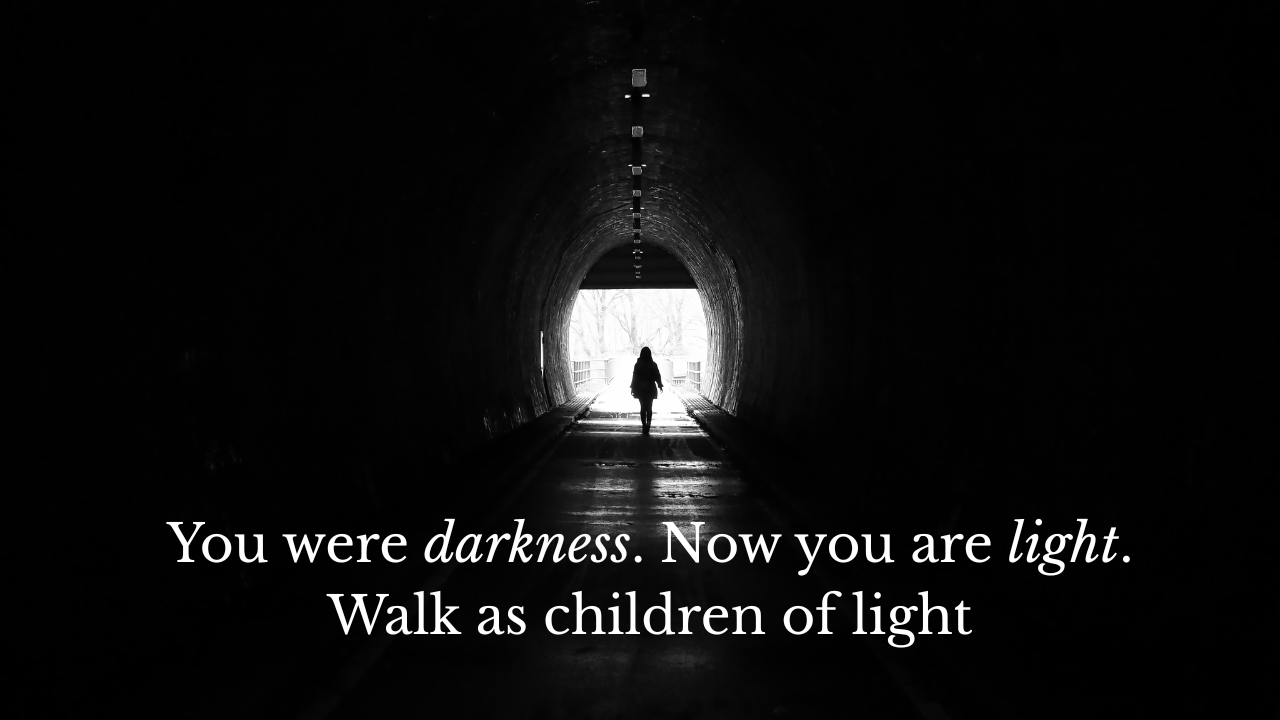
But because of Christ, a contrast does exist, and that contrast must be lived out. Therefore, Paul says, do not become their partners. For you were once darkness, but now you are light in the Lord (Eph. 5:7–8). Paul utilizes another contrast in order to emphasize the reality of life in Christ. Without Christ, we are darkness; with Christ, we are light. God does the work of redemption; those who are redeemed provide testimony of God’s wisdom and goodness to the rest of creation (cf. Eph. 3:10). Living any way other than walking as children of light (Eph. 5:8c) distorts that testimony does not accurately reflect the scope of God’s redemption.
Furthermore, walking as children of light means (1) we don’t participate in the fruitless works of darkness; (2) but instead expose them (Eph. 5:11). In addition to living vice-free lives, we are to expose the vices. This needs clarification.
The command to expose the works of darkness in Ephesians 5:11 means Christians do need to draw a line in the sand on virtues and vices. It abhorrent to call that which is good ‘evil’ and that which is evil ‘good’. However, we are not permitted to communicate that line however we see fit. Ephesians 5:11 is not commanding us to:
- Be the loudest ones in the room
- To shout “sinners” down
- To picket and protest with hostility
- To make others feel hated
- To evaluate “sinners” as undeserving of empathy
The Greek word translated as expose in Eph. 5:11 is ἐλέγχετε (elegchete). It has 4 possible definitions / meanings. The job of the Bible interpreter is to determine which definition Paul intends his audience to understand as the correct one. We determine this by looking at how Paul uses the word, and how that word relates to the other words around it.
In the case of Ephesians 5:11, the appropriate definition of ἐλέγχετε (elegchete) is the following: “to scrutinize or examine carefully, bring to light, expose, set forth… the darkness-light theme suggests exposure, with implication of censure.” This definition emphasizes the concept of “shedding light” upon something, which offers the best harmonization with verse 13 where this same word is used again: Everything exposed by the light is made visible (Eph. 5:13). The light is what does the exposing. Therefore, when following the command to expose the works of darkness in Ephesians 5:11, the task for Christians is to help those living in darkness to see the contrast between darkness and light; we are to point to and explain the contrast made evident by the light Christ shines upon the world– as Paul says in conclusion: for what makes everything visible is light. Therefore it is said: Get up sleeper, and rise up from the dead, and Christ will shine upon you (Eph. 5:14; see also Colossians 4:6 and 1 Peter 3:15–16).
Consistency In The Christian Life (5:15–21)
15 Pay careful attention, then, to how you walk—not as unwise people but as wise—16 making the most of the time,, because the days are evil. 17 So don’t be foolish, but understand what the Lord’s will is. 18 And don’t get drunk with wine, which leads to reckless living, but be filled by the Spirit: 19 speaking to one another in psalms, hymns, and spiritual songs, singing and making music with your heart to the Lord, 20 giving thanks always for everything to God the Father in the name of our Lord Jesus Christ, 21 submitting to one another in the fear of Christ.
Ephesians 5:15–21 (CSB)
This section can be summarized as the following: live lives that adhere to God’s vision for His redeemed people. We are to Pay careful attention, then, to how you walk– not as unwise people but as wise– making the most of the time (Eph. 5:15–16a). We are supposed to evaluate the way we practice our faith against God’s vision for His redeemed people, which is what Paul has been explaining throughout chapters 4–5. In stead of living foolishly, we are to understand what the Lord’s will is. Drunkenness leads to debauchery (Eph. 5:18), which is a waste of time (cf. Proverbs 20:1). But Christians are commanded to be making the most of the time (Eph. 5:16), which is why we are to be filled by the Spirit (Eph. 5:18), which will result in speaking to one another in psalms, hymns, and spiritual songs, singing and making music with your heart to the Lord, giving thanks always for everything to God the Father in the name of our Lord Jesus Christ, submitting to one another in the fear of Christ (Eph. 5:19–21).
Wives And Husbands (5:22–33)
22 Wives, submit, to your husbands as to the Lord, 23 because the husband is the head of the wife as Christ is the head of the church. He is the Savior of the body. 24 Now as the church submits to Christ, so also wives are to submit to their husbands in everything. 25 Husbands, love your wives, just as Christ loved the church and gave himself for her 26 to make her holy, cleansing her with the washing of water by the word. 27 He did this to present the church to himself in splendor, without spot or wrinkle or anything like that, but holy and blameless. 28 In the same way, husbands are to love their wives as their own bodies. He who loves his wife loves himself. 29 For no one ever hates his own flesh but provides and cares for it, just as Christ does for the church, 30 since we are members of his body. 31 For this reason a man will leave his father and mother and be joined to his wife, and the two will become one flesh., 32 This mystery is profound, but I am talking about Christ and the church. 33 To sum up, each one of you is to love his wife as himself, and the wife is to respect her husband.
Ephesians 5:22–33 (CSB)
This section begins the topic known as “household codes.” From Ephesians 5:22–6:9, Paul explains how individuals within a household are to conduct themselves in relation to one another. The depth to which we could study this passage greatly exceeds the scope of a beginner walkthrough of the material. So, we are going to focus on the big picture Paul presents– honestly, it is my opinion that a big-picture understanding is the first step to understanding the specific and deeper details.
I have to point something out from the Greek text that you won’t easily notice in our English translations. Verses 22–33 are the ways members of a household are instructed to practice submitting to one another in the fear of Christ (Eph. 5:21), which itself is one of the ways in which Christians pay careful attention to how they walk and make the most of the time (Eph. 5:15–16). Despite the paragraph break, this section on wives and husbands is deeply connected to the preceding concepts of chapter 5. With that said, let’s look at the big-picture details.
First, this section is for wives and husbands, not women and men. Paul is not commanding unmarried women to submit to men.
Second, the instructions to the wives (5:22–24) is significantly shorter than the instructions to the husbands (5:25–33). My point in saying that is this: the burden of a Godly household is not hinging solely upon “how well the wife submits.” This is often not emphasized enough when American Protestants teach on this section.
Third, the language and imagery throughout this whole section directs our eyes up to Christ and the Church. Consider the following examples where the bold text illustrates this:
- Wives, submit to your husbands as to the Lord (5:22)
- The husband is the head of the wife as Christ is the head of the church (5:23)
- He [Christ] is the savior of the body (5:23)
- As the church submits to Christ, so also wives are to submit… (5:24)
- Husbands, love your wives as Christ loved the church (5:25)
- He [Christ] did this (5:27)
- For no one ever hates his own flesh but provides and cares for it, just as Christ does for the church (5:29)
- This mystery is profound, but I am talking about Christ and the church (5:32).
Part of the vision for walking as wise people (cf. Eph. 5:15) is for wives and husbands to reflect the relationship between Christ and the church. Wives are instructed to submit to and respect their husbands (Eph. 5:22, 33), and husbands are instructed to love their wives as Christ loved the church (Eph. 5:25–33).
Christ gave himself for her [the Church] (Eph. 5:25). This verse is not communicating that husbands who are willing to die for their wives (should circumstances present themselves) are adequately fulfilling this command. Paul explains that the reason Christ gave himself for the Church was in order to make her holy, cleansing her with the washing of water by the word. He did this to present the church to himself in splendor, without spot or wrinkle or anything like that, but holy and blameless (Eph. 5:26–27). Christ gave Himself for the Church so that the two of them could have a beautiful relationship afterwards. While having the mindset of sacrificing yourself for your wife is noble and appropriate should the circumstances demand it, that is not the goal of Paul’s instructions to husbands. Being irritated by your wife but then dying for her in a moment of Medieval chivalry would not fulfill Paul’s instructions. Instead, these instructions require husbands to live for the purpose of loving their wives, not being served by them. A Husband should love his wife as he loves himself for the purpose of being able to present his wife to Christ as built-up, protected, cherished, loved, holy, blameless, and stewarded well. The union between wives and husbands should reflect the union between Christ and the Church.
Concluding Thoughts
That’s chapter 5!
Here are some concluding thoughts to frame our understanding:
- We are to live as dearly loved children of God, which means we are to be imitators of God (Eph. 5:1). This is both a standard and a goal. The presence of God within our lives should result in a life lived differently than those without God. We need God’s help to do this.
- The vices Paul instructs us to avoid are destructive to more than just us and others; they stain our testimony about who God is and His wisdom (cf. Eph. 3:10).
- We must understand the strength of the contrast between the works of darkness and the works of light (Eph. 5:6–14). This requires much more than a basic awareness that sexual immorality is bad and “I/you/we shouldn’t do it.” We must learn to feel the goodness that undergirds the light. This requires us to continually pour over Scripture’s descriptions of the works of light and meditate on them.
- Once we properly understand the contrast between darkness and light, we are then called to expose the darkness by helping others see the light and its beauty. The power of darkness disappears in the presence of light (Eph. 5:11–14).
- A Christian’s life is to be lived in light of the wisdom of God. This means we don’t drift along in purposelessness; we don’t assume drunkenness is an appropriate use of our time. Instead, we must understand what the Lord’s will is (Eph. 5:17). This refers to a big-picture understanding of God’s will for all Christians, not for individual Christians at an individual level. God’s will is for us to be filled with the fullness of God and His Spirit (Eph. 3:19; 5:18). This comes through consistent and humble communion with God.
- The union between husbands and wives is to reflect the union between Christ and the church. This is a deep mystery. Husbands are called to love their wives in a sacrificial way that leads to life and deeper unity with their wives. Wives are called to submit to their husbands as to the Lord. Neither is easy. The union of marriage is for the purpose of holiness, and both parties need Christ’s help to live up to the calling.
Only 1 more chapter to go! Keep seeking God through His Word, and we’ll see you in chapter 6.
Until then,
Happy Bibleing!


Leave a Reply