
Introduction
I taught a seminar recently on how to study the Bible. I distinguish between Reading, Studying, and Meditating through the Bible, and the goal of the seminar was to explain a few basic fundamentals about Bible study and then have the students practice various study techniques. I thought the introductory material would be a reminder of things they’ve already been taught because nobody in the room was an absolute beginner at Bible study– we even had multiple people who had attended Christian universities.
That’s why I was surprised when they said this material so helpful!
What was the material I presented? It wasn’t about word studies. It wasn’t historical context. It wasn’t how to understand Jesus’ parables.
It was how to understand the Bible they already have– the one they open to engage with God through His word.
To clarify, I’m not talking about understanding what the Bible means. I’m talking about understanding what your Bible Translation Committee has presented you in the form of whatever Bible translation you’re using.
You see, most English translations are produced by a publisher and a translation committee. The publisher and the committee decide how they are going to translate the text, which manuscripts they will work from, how they want the English to flow, how they will handle gendered language, where they will place section breaks, etc. Every translation of the Bible is first an interpretation of the text in the original languages. As a Bible student, you want to know how the translation committee and publisher compiled and presented the version you are using.
So, here are some of the most important things you should learn about your Bible.
Bible Study Tips
- Develop a mindset for study
- Understand Your Bible
What To Know About Your Bible To Maximize Your Bible Study
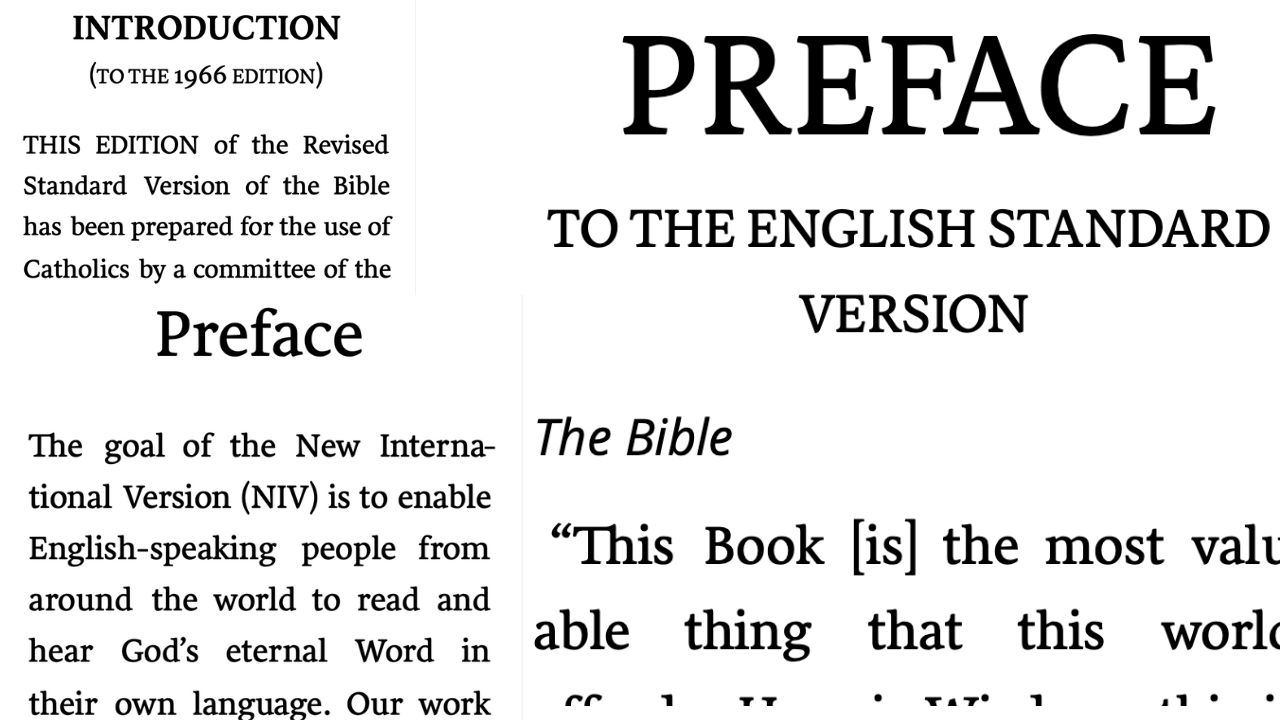
You should be able to find the following information in the “Preface” or “Introduction” to your Bible.
Translation Philosophy
This is probably the single most important thing for you to understand. The committee’s translation philosophy determines many other things about your experience in the text– the readability of the text, where paragraph breaks occur, the balance between modern and archaic language, etc.
There are three translation philosophies: Formal Equivalent, Dynamic Equivalent, and Optimal Equivalent. You can read more about each one here.
It is important to know the translation philosophy behind the version you’re studying because it affects the degree to which you can study. It is easier, for example, to notice structural elements within the text of a formal equivalent translation than a dynamic equivalent. Structural elements refer to how one paragraph relates to another– are they completely independent; does ‘paragraph B’ flow out of ‘paragraph A’; is the same topic being discussed across multiple paragraphs? These types of observations do not require any commentaries or Bible dictionaries, but it is helpful to know your Bible’s translation philosophy so you will be able to notice these clue’s to the biblical writer’s meaning.
Footnotes and Cross References
Most Bibles have either footnotes, cross references, or both. I have an ESV that only has footnotes. I also have a CSB that has both footnotes and cross references.
Footnotes contain additional information for the reader. These are often explaining translation or interpretive options. For example, the ESV has a footnote at the end of Matthew 5:26 that explains the type of Roman coin discussed in that passage. Another example is the end of Matthew 5:37 in the ESV. Here, the footnote explains a different manuscript reading. These are notes that explain either the text itself or a decision made by the committee.
Cross references alert the reader that this passage refers to another passage somewhere else in the Bible. That reference could be a direct quotation; it could be a partial quote; it could also be the biblical writer merely alluding to another passage. Cross references are not a magic cypher code. They allow the modern reader to know when the biblical writer likely has another passage from Scripture in mind– sometimes that’s obvious (direct quote); sometimes it is more subjective from the translation committee (for example: the ESV places a cross reference to 1 Cor. 13:6 at 2 John 2).
Footnotes and cross references are both marked within the text by superscripts– these are small letters or numbers at the end of a word / sentence that sit above the word they follow. Footnotes are usually numbered (1, 2, 3, etc.). Cross references are usually lower-case letters (a, b, c, etc.). If a chapter has a high number of cross references, the alphabet will be recycled and add a second letter (aa, ab, ac. etc.). You want to know if a superscript is a cross reference or a footnote so you can look in the correct place. Footnote are usually located at the bottom of the page. Cross References are often within a small vertical column in the middle of the page (in between the two columns of text).
Gendered Language
This may seem insignificant, but it matters. Some Greek words can refer both to men and to mixed company. It is important to know how your English translation handles gendered language so that you know how much weight to place on a word that is exclusively gendered. It would be easy to assume the writer is only referring to men, when, in fact, he may be referring to men and women.
Acts 1:16 provides a great example. Consider how the ESV translates this verse compared the the NIV (2011):
| ESV | NIV (2011) |
| “Brothers, the Scripture had to be fulfilled, which the Holy Spirit spoke beforehand by the mouth of David concerning Judas, who became a guide to those who arrested Jesus.” | and he said, “Brothers and sisters, the Scripture had to be fulfilled in which the Holy Spirit spoke long ago through David concerning Judas, who served as a guide for those who arrested Jesus.” |
Which one is ‘correct’? The underlying Greek word usually refers to a man or a husband, but the previous verse tells us women were among those to whom Peter is speaking. Should we understand this to mean Peter is only addressing the men?
Another example is 1 John 2:12–14:
12 I am writing to you, little children,
because your sins are forgiven for his name’s sake.
13 I am writing to you, fathers,
because you know him who is from the beginning.
I am writing to you, young men,
because you have overcome the evil one.
I write to you, children,
because you know the Father.
14 I write to you, fathers,
because you know him who is from the beginning.
I write to you, young men,
because you are strong,
and the word of God abides in you,
and you have overcome the evil one.
1 John 2:12–14 ESV
Is John exclusively speaking to children, fathers, and young men? John frequently refers to everyone within the congregations he’s writing to as “children.”
Maybe you’ve never thought about it before, but we want to think carefully about gendered language within the biblical text. Your translation committee should explain their approach to gendered language in the Preface / Introduction to your Bible. What we need to avoid is placing a lot of weight on a gendered word that the writer did not intend to be weighted. Some passages are making distinctions between genders, but others aren’t. These interpretations matter because their logical conclusions will eventually affect the way we practice our faith.
Names For God
It is helpful to know how your Bible presents the names of God. The CSB includes the following list in its Introduction (I added the table):
| Hebrew Word | CSB English |
| Elohim | God |
| YHWH (Yahweh) | LORD |
| Adonai | Lord |
| Adonai Yahweh | Lord God |
| Yahweh Sabaoth | Lord of Armies |
| El Shaddai | God Almighty |
Knowing the underlying Hebrew word can be helpful, so this is just another thing to familiarize yourself with in your Bible.
Weights and Measures
Some English versions translate weights and measures into modern units of measurement for readability. Others do not. Either way, it is helpful to understand how the translation committee handled weights and measures throughout the text. Also, there will be a table with conversions either at the beginning or end of the biblical text if your version does not modernize the units of measurement.
Disputed Passages
This might be startling news to you, but there are passages within the Bible that are disputed… what exactly does that mean?
We’re not talking about disputed interpretations of passages. We’re talking about passages that seem to have been added to the biblical text over time. Scholars can trace this through comparing manuscripts. Verses & passages that occur in later manuscripts but aren’t in older manuscripts are scrutinized. This process is called “textual criticism.” Textual criticism is important because it seeks to determine the reading of the original manuscripts.
Here are a few brief reasons why words, verses, and passages were added to the biblical text over the centuries:
Harmonization: some scribes attempted to harmonize the stories between Matthew, Mark, and Luke in later centuries. If Matthew used a word that Mark omitted, then a well-intentioned scribe might have inserted that word into Mark.
Marginal Notes: some scribes wrote brief commentaries or parallel passages in the margins of a manuscript. A later scribe might be using that manuscript as the source for his copy, and he might not be able to distinguish between the biblical text and the marginal notes.
Scribal Error: sometimes scribes made errors. These errors are easy to trace.
Again, it is easy to get alarmed that words, verses, and passages were added over time, but the branch of textual criticism has a thorough process for examining these variants that is beyond what I can explain here. If you’d like to know more, here is a playlist that THOROUGHLY explains the textual criticism process.
It is good to familiarize yourself with how your English version handles these disputed passages. Most likely, they will be included within the text with some sort of indicator that the passage is disputed.
Conclusion
It may seem obvious, but your Bible is the first tool you use in Bible study. It will go a long way to simply know how the publishers and translating committee of your preferred version have translated and presented the text to you. Bible study is about investigating the text, asking questions, and finding answers to those questions for the purpose of knowing God. The Preface / Introduction to your Bible will help you navigate that process better.
Happy Bibleing!


Leave a Reply