
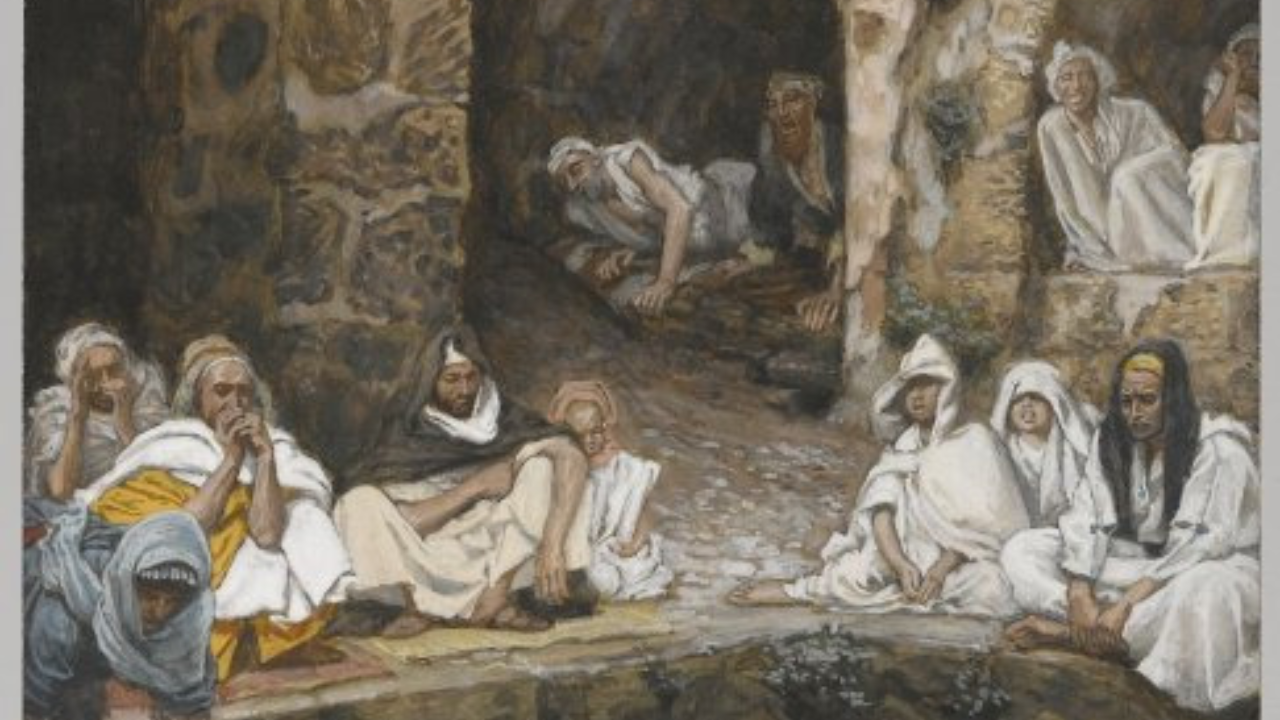
One man was there who had been an invalid for thirty-eight years. When Jesus saw him lying there and knew that he had already been there a long time, he said to him, “Do you want to be healed?” The sick man answered him, “Sir, I have no one to put me into the pool when the water is stirred up, and while I am going another steps down before me.” Jesus said to him, “Get up, take up your bed, and walk.” And at once the man was healed, and he took up his bed and walked. Now that day was the Sabbath.
John 5:5–9 ESV
The New Testament writers frequently refer to the Old Testament Scriptures through direct quotes, allusions, and echoes. We will better understand the New Testament if we can wrap our minds around how its writers reference the Old Testament.
One such occurrence is when Jesus heals the disabled man in John 5.
Setting the Scene
John 5:7 indirectly echoes Psalm 142. An ‘indirect echo’ means the Old Testament passage is not directly quoted or alluded to, but there are distinct parallels between the Old and New Testament passages; these parallels often relate to the imagery of scene being described. This kind of imagery is also called typology. The disabled man in John 5:7 tells Jesus that he has no one to assist him into the water when it is stirred. Christ acts for this man in a way that David longed for in Psalm 142.
John 5:1–16 (ESV)
The Healing at the Pool on the Sabbath
5 After this there was a feast of the Jews, and Jesus went up to Jerusalem.
2 Now there is in Jerusalem by the Sheep Gate a pool, in Aramaic called Bethesda, which has five roofed colonnades. 3 In these lay a multitude of invalids—blind, lame, and paralyzed. 5 One man was there who had been an invalid for thirty-eight years. 6 When Jesus saw him lying there and knew that he had already been there a long time, he said to him, “Do you want to be healed?” 7 The sick man answered him, “Sir, I have no one to put me into the pool when the water is stirred up, and while I am going another steps down before me.” 8 Jesus said to him, “Get up, take up your bed, and walk.” 9 And at once the man was healed, and he took up his bed and walked.
Now that day was the Sabbath. 10 So the Jews said to the man who had been healed, “It is the Sabbath, and it is not lawful for you to take up your bed.” 11 But he answered them, “The man who healed me, that man said to me, ‘Take up your bed, and walk.’ ” 12 They asked him, “Who is the man who said to you, ‘Take up your bed and walk’?” 13 Now the man who had been healed did not know who it was, for Jesus had withdrawn, as there was a crowd in the place. 14 Afterward Jesus found him in the temple and said to him, “See, you are well! Sin no more, that nothing worse may happen to you.” 15 The man went away and told the Jews that it was Jesus who had healed him. 16 And this was why the Jews were persecuting Jesus, because he was doing these things on the Sabbath.
Psalm 142 (ESV)
You Are My Refuge
142 A Maskil of David, when he was in the cave. A Prayer.
1 With my voice I cry out to the Lord;
with my voice I plead for mercy to the Lord.
2 I pour out my complaint before him;
I tell my trouble before him.
3 When my spirit faints within me,
you know my way!
In the path where I walk
they have hidden a trap for me.
4 Look to the right and see:
there is none who takes notice of me;
no refuge remains to me;
no one cares for my soul.
5 I cry to you, O Lord;
I say, “You are my refuge,
my portion in the land of the living.”
6 Attend to my cry,
for I am brought very low!
Deliver me from my persecutors,
for they are too strong for me!
7 Bring me out of prison,
that I may give thanks to your name!
The righteous will surround me,
for you will deal bountifully with me.
Observations in Psalm 142
Psalm 142 was written by David when he was hiding in the cave (Ps. 142:0). This could refer to either 1 Sam. 22:1 or 24:3.1 In verses 1–2, David expresses that he cries to the LORD in response to his circumstances. In verse 3, he says God is the one who watches over him and that enemies have laid snares for him. Verses 4–7 reveal that David has no one “at my right hand; no one is concerned for me” (v.4); David’s only strategy and comfort is to cry to God because God is his “portion in the land of the living” (v.5); finally, David asks for deliverance from his enemies and to be freed from his prison so that he may praise God’s name (vv.6–7). While this Psalm is not directly quoted, it has typological significance for the disabled man in John 5 as well as John’s overall argument in his Gospel.
Psalm 142 & John 5:7
The disabled man echoes David’s desperation: he too lacks anyone who expresses concern for him or values his life (John 5:7; cf. Ps. 142:4). The narrative implies his condition rendered him immobile without miraculous intervention (cf. John 5:3–8). This places the man in his own prison of confinement similar to David in the cave (cf. Ps. 142:7). Jesus is the fulfillment of David’s request in Psalm 142, and He is the contrast against everyone who had no concern for the man. He noticed and sought the man (John 5:6; cf. Ps. 142:3–4); He delivered this man from his prison of immobility, which implies that Jesus is the man’s portion in the land of the living (John 5:8, 14, 21, 25–29; cf. Ps. 142:5–7).
This healing is more than a physical healing. It is the restoration of a discarded man’s life. This narrative and the discourse that follows continues the motif how the logos has life within Him and is Himself the light of mankind (cf. John 1:4).
Footnotes
- 1 Samuel 22:1 (ESV) — 1 David departed from there and escaped to the cave of Adullam. And when his brothers and all his father’s house heard it, they went down there to him.
1 Samuel 24:3 (ESV) — 3 And he came to the sheepfolds by the way, where there was a cave, and Saul went in to relieve himself. Now David and his men were sitting in the innermost parts of the cave. ↩︎
Leave a Reply