
3 And the tempter came and said to him, “If you are the Son of God, command these stones to become loaves of bread.” 4 But he answered, “It is written, “ ‘Man shall not live by bread alone, but by every word that comes from the mouth of God.’ ”
Matthew 4:3–4 (ESV)
Introduction
The New Testament writers frequently refer to the Old Testament Scriptures through direct quotes, allusions, and echoes. We will better understand the New Testament if we can wrap our minds around how its writers refer to the Old Testament.
Perhaps the most famous instance of this is when Jesus responds to the devil’s temptations in the wilderness. In all three responses, Jesus “for it is written” and then quotes the Old Testament.
Today, we will focus on the first temptation, the command to turn stones to bread, and Jesus’ response.
Setting the Scene
Jesus quotes part of Deuteronomy 8:3 in His response to the devil’s first temptation: that Jesus, if He is indeed the Son of God, should command the stones to become bread.
Instead of taking the bait to prove His identity, Jesus refuses with an appeal to Deuteronomy 8:3.
Matthew 4:1–4 (ESV)
The Temptation of Jesus
1 Then Jesus was led up by the Spirit into the wilderness to be tempted by the devil. 2 And after fasting forty days and forty nights, he was hungry. 3 And the tempter came and said to him, “If you are the Son of God, command these stones to become loaves of bread.” 4 But he answered, “It is written, “ ‘Man shall not live by bread alone, but by every word that comes from the mouth of God.’ ”
(bold added for emphasis)
Deuteronomy 8:1–5 (ESV)
Remember the LORD your God
1 “The whole commandment that I command you today you shall be careful to do, that you may live and multiply, and go in and possess the land that the Lord swore to give to your fathers. 2 And you shall remember the whole way that the Lord your God has led you these forty years in the wilderness, that he might humble you, testing you to know what was in your heart, whether you would keep his commandments or not. 3 And he humbled you and let you hunger and fed you with manna, which you did not know, nor did your fathers know, that he might make you know that man does not live by bread alone, but man lives by every word that comes from the mouth of the Lord. 4Your clothing did not wear out on you and your foot did not swell these forty years. 5 Know then in your heart that, as a man disciplines his son, the Lord your God disciplines you.
(bold added for emphasis)
Observations in Deuteronomy 8:3
Deuteronomy 8:3 is part of Moses’ ‘Second Address’ to the nation of Israel within Deuteronomy. The Second Address focuses on the Ten Commandments. They are given for the second time in Deut. 51, and then Deut. 6:1–26:15 elaborate on each Commandment in turn. Deuteronomy 8:3 is part of the elaboration on the First Commandment: “you shall have no other gods before me” (Deut. 5:7, ESV). Deuteronomy 8:3 is dependent upon 8:2, which commands Israel to remember everything about how God led them through the wilderness 40 years. The majority of 8:3 explains how God humbled Israel through hunger and undesired food, so “that he might make you know that man does not live by bread alone, but man lives by every word that comes from the mouth of the LORD” (ESV). Deuteronomy 8:3 communicates that God developed Israel’s understanding of humanity’s need to know that life comes from what God says, and this lesson was learned through the experience of real human hunger and God’s provision.
Deuteronomy 8:3 & Matthew 4:3–4
Matthew intends for us to pick up on many of these themes in the temptation of Jesus. The devil’s first temptation is to entice Jesus to act upon His identity as the Son of God (Matt. 4:3). His opening of “if you are the Son of God” assumes for the sake of argument that Jesus is the Son of God. Such a reality would enable Jesus to command the stones around Him to become bread, and they would in fact become bread. While Matthew hasn’t fully developed what ‘Son of God’ means at this point in his Gospel, the devil implies that it contains authority over nature to change the very substance of nature.
Jesus’ response, however, hinges upon a human identity, not a divine one: “it is written, a person does not live on bread alone, but on every word that comes from the mouth of God.” Jesus’ reason for not turning the stones into bread is because of how humans are to view God’s provision in light of the circumstances of real hunger (cf. Matt. 4:2).
The lingering question is: how much of the preceding explanation of humility through hunger in Deut. 8:3 should we understand Jesus to be subjected to and experiencing? The fact that Jesus humanized Himself in His refutation to the devil in 4:4 suggests He is, in fact, doing just that.
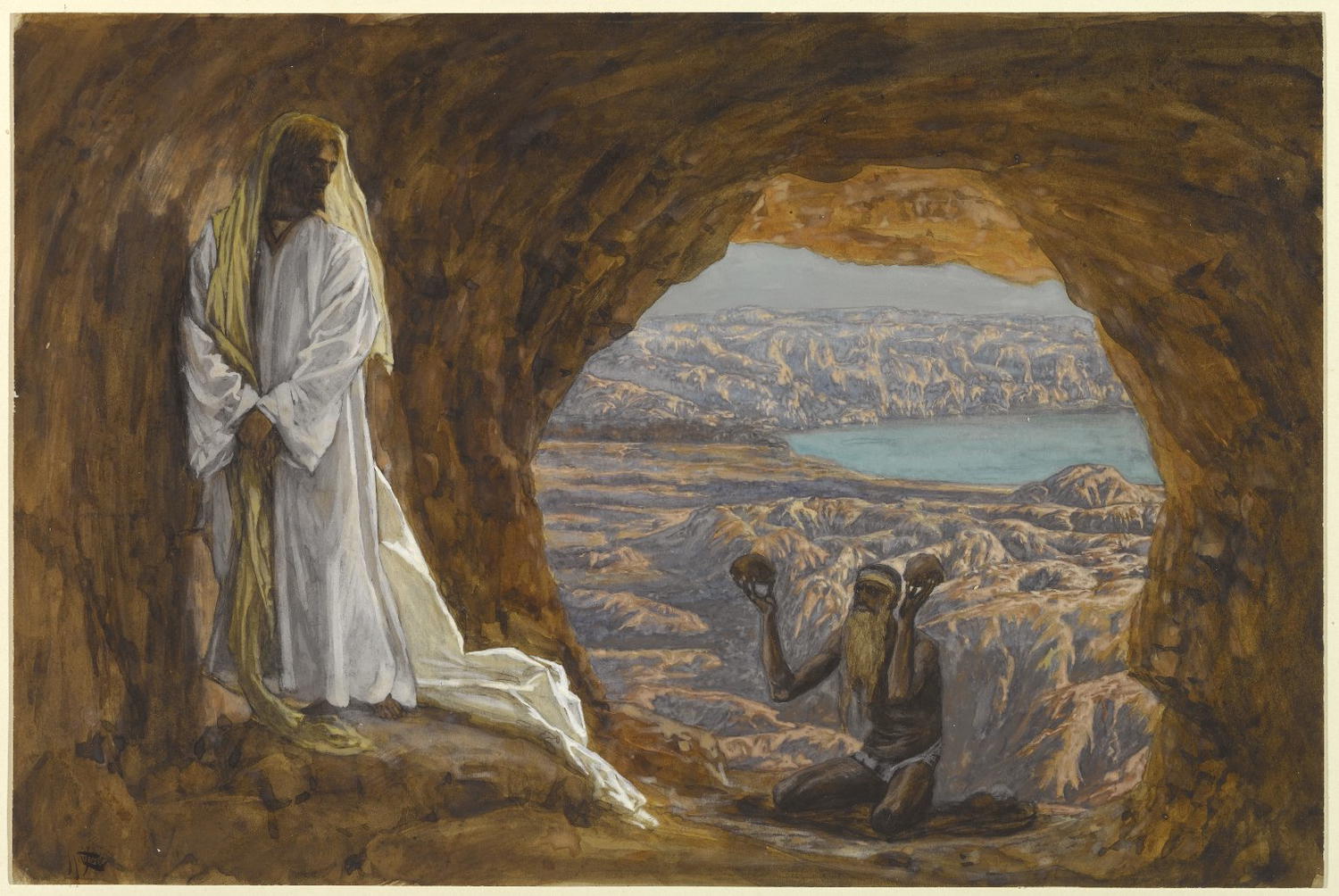
featured image: Jesus Tempted in the Wilderness (Jésus tenté dans le désert) by James Tissot, Brooklyn Museum.
Footnotes
- The first time the Ten Commandments were given was in Exodus 20. The Commandments in Exodus 20 were given to the actual Exodus generation. The Commandments in Deuteronomy 5 were given to the Second Generation, the ones who grew up in the wilderness for 40 years. ↩︎


Leave a Reply