
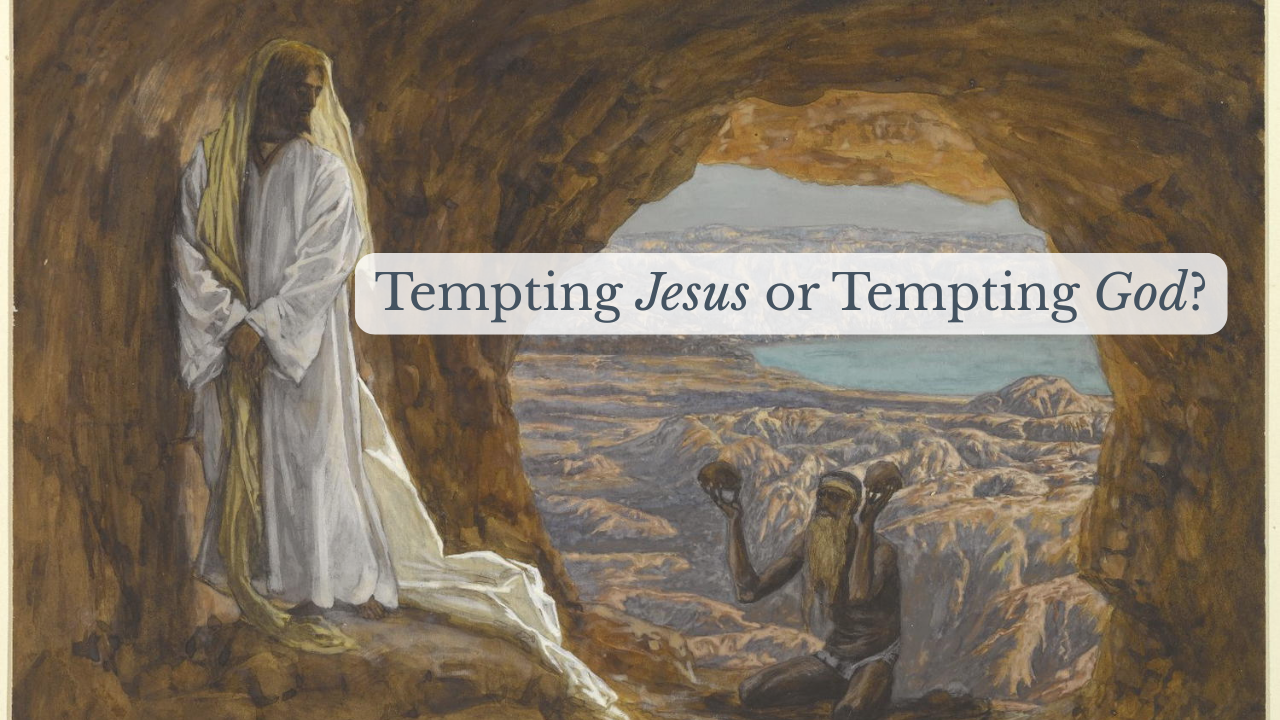
This post discusses five words within Jesus’ temptation in the wilderness and how those words communicate theological imagery and nuance. It can be difficult to understand what we’re actually doing in this type of study, so allow me to briefly explain it before we begin. If you’d rather, you may skip down to the study itself.
The Role of ‘Preunderstanding’ in our Bible Study
There is something that both helps and hurts you when it comes to understanding Scripture: your preunderstanding.
‘Preunderstanding’ refers to everything you know/believe about Christianity, practicing the faith, interpreting the Bible… all of it.
Two aspects of preunderstanding come to play when we look at the Gospels:
- Matthew, Mark, and Luke tell very similar accounts of Jesus’ life and ministry.
- We know from Christian doctrine that Jesus is both fully human and fully divine.
Both of these preunderstandings will influence how you read the Gospel narratives. Here is how they might affect you:
| Preunderstanding | Positive Influence | Negative Influence |
| Matt., Mark, Luke are similar | You expect to see overlap between the three books, and the differences between them stand out more. | You might assume that all three writers are saying the same thing about Jesus and that their differences are merely different ways of saying the same thing. |
| Jesus is both fully human and fully divine | You know the truth about Jesus. | You might assume each passage in the Gospels communicates both Jesus’ divinity and humanity equally. |
Understanding how preunderstanding influences us allows us to move slower through the text and notice how the details drive the meaning. Being unaware of how preunderstanding works often results in us glossing over significant details and assuming the text is somehow/someway affirming what we already believe.
Thus, word studies like this one allow us to pierce through our preunderstanding to see the writer’s intended meaning of the text and then re-formulate our preunderstanding based on that meaning.
Examining the Temptation of Jesus
The language of Jesus’ temptation in Matthew 4:1–11 reveals a lot about what Matthew wants us to know about Jesus, and what the devil believes about Jesus and God.
The words we are going to examine are bolded and italicized below.
Matthew 4:1–11 (ESV)
1 Then Jesus was led up by the Spirit into the wilderness to be tempted by the devil.
2 And after fasting forty days and forty nights, he was hungry.
3 And the tempter came and said to him, “If you are the Son of God, command these stones to become loaves of bread.”
4 But he answered, “It is written, “ ‘Man shall not live by bread alone, but by every word that comes from the mouth of God.’ ”
5 Then the devil took him to the holy city and set him on the pinnacle of the temple
6 and said to him, “If you are the Son of God, throw yourself down, for it is written, “ ‘He will command his angels concerning you,’ and “ ‘On their hands they will bear you up, lest you strike your foot against a stone.’ ”
7 Jesus said to him, “Again it is written, ‘You shall not put the Lord your God to the test.’ ”
8 Again, the devil took him to a very high mountain and showed him all the kingdoms of the world and their glory.
9 And he said to him, “All these I will give you, if you will fall down and worship me.”
10 Then Jesus said to him, “Be gone, Satan! For it is written, “ ‘You shall worship the Lord your God and him only shall you serve.’ ”
11 Then the devil left him, and behold, angels came and were ministering to him.
“Led Up (v.1)
The verb “led up” (Greek ἀνάγω / anagō) is one of the differences between Matthew’s account of Jesus’ temptation and Mark’s. Mark says “And immediately, the Spirit drove Him [Jesus] into the desert” (Mark 1:12, translation and emphasis mine).
Mark emphasizes the Holy Spirit in this interaction. Matthew, however, emphasizes Jesus and that He was led by the Spirit into the wilderness.
Someone with familiarity of the Old Testament while reading Matthew’s account would immediately draw a parallel between Jesus being led into the wilderness by God and the nation of Israel being led into the wilderness by God after the Exodus (cf. Exodus 13:17–22). Matthew intends his readers to make this connection between the human Jesus and the nation of Israel.
“To Be Tempted” (v.1)
This verbal phrase is one word in Greek (πειρασθῆναι / peirasthēnai), and it tells us the purpose for Jesus being sent into the wilderness. There are a few things peirasthēnai could mean, but the fact that the devil is the one who will do the peirasthēnai-ing tells us we should expect something severe. In this context, the concept behind “to be tempted” is to entice to improper behavior.1
On the surface, this might not seem all that significant. However, this actually sheds light on the devil’s understanding of Jesus’ identity contrasted against the identity being proposed through Matthew’s narrative.
This begs the following question: is the devil trying to entice Jesus to practice behavior that is improper for the divine Son of God or to practice behavior that is improper for a human seeking to faithfully follow God?
Again, we must keep the imagery of Jesus’ connection with Israel’s journey through the wilderness in mind.
“Came” (v.3)
This is another word that describes the devil’s actions. Again, we might be tempted to gloss over this word without thinking twice, but it actually contributes to the theological picture Matthew is painting.
The underlying Greek word is προσέρχομαι (proserchomai). It is a fairly common word, so this is an instance where the context brings the theological weight more so than the definition.
Proserchomai means to move towards… approach.2 It is actually this definition plus the verb tense in Greek that drives the theological imagery. The verb tense emphasizes that the devil delivered his first temptation as he approached Jesus. It was a sly strategy, which communicates the devil believed in the strength of his first temptation.
“Strike” (v.6)
This word brings us to the second temptation. After Jesus overcame the first temptation by quoting Scripture, the devil tries to use Scripture against Him. The devil quotes Psalm 91:11–12 where the Psalmist says the angels will lift the individual spoken of so no harm comes to him.
The underlying Hebrew word in Psalm 91:12 is נָגַף (nāgap̄ / NAH-gaf), which means to strike or smite.3 The imagery of lifting up in order to prevent the striking implies contact of any sort as opposed to violent contact.
This is the same concept and imagery behind the corresponding Greek word in Matthew 4:6 (Greek προσκόπτω / proskoptō). The devil’s temptation is for Jesus to put God in a situation where He must act in order to remain faithful to who He is. Such action, because of the context of Psalm 91, would just so happen to deliver the one who considers God his “fortress” from the threat of evil (cf. Psalm 91:1–12).
By identifying as human in the first temptation, Jesus is tempted to force God into protecting His human servant.
“Ministering” (v.11)
Once the devil is defeated and flees, the angles come and “minister” to Jesus. Our Greek word here (διακονέω / diakoneō), means to function as an intermediary… to be at one’s service… to meet an immediate need.4
On the surface, that definition could have a broad range of implications. The context of Matthew’s temptation, however, suggests the angels’ “ministry” was to provide food.
Jesus has been depicted as very human throughout the temptation, and the Old Testament has many instances of God providing food to His people either miraculously or through angels:
- God provides manna to Israel in the wilderness (Exodus 16:4–5, 13–35)
- God provides bread for Elijah in the wilderness and an angel ministers to him (1 Kings 19:1–8).
The temptation of Jesus concludes with Him being cared for by God in the same way that God had cared for His people and servants in the past.
At this point in the story, Matthew wants the reader to know that Jesus is a very human servant of the Lord.
Conclusion
Word studies allow us to delve deeper into the truths of God if we set aside what we think we already know. In the case of Matthew’s account of Jesus being tempted by the devil, we are able to conclude that Matthew wants to emphasize Jesus as a faithful, human, servant of the Lord. Jesus is led into the same situations as the Israelites were, but Jesus will remain triumphant where all others failed.
Footnotes
- William Arndt et al., A Greek-English Lexicon of the New Testament and Other Early Christian Literature (Chicago: University of Chicago Press, 2000), 793. ↩︎
- William Arndt et al., A Greek-English Lexicon of the New Testament, 878. ↩︎
- Francis Brown, Samuel Rolles Driver, and Charles Augustus Briggs, Enhanced Brown-Driver-Briggs Hebrew and English Lexicon (Oxford: Clarendon Press, 1977), 619. ↩︎
- William Arndt et al., A Greek-English Lexicon of the New Testament, 229. ↩︎


Leave a Reply