
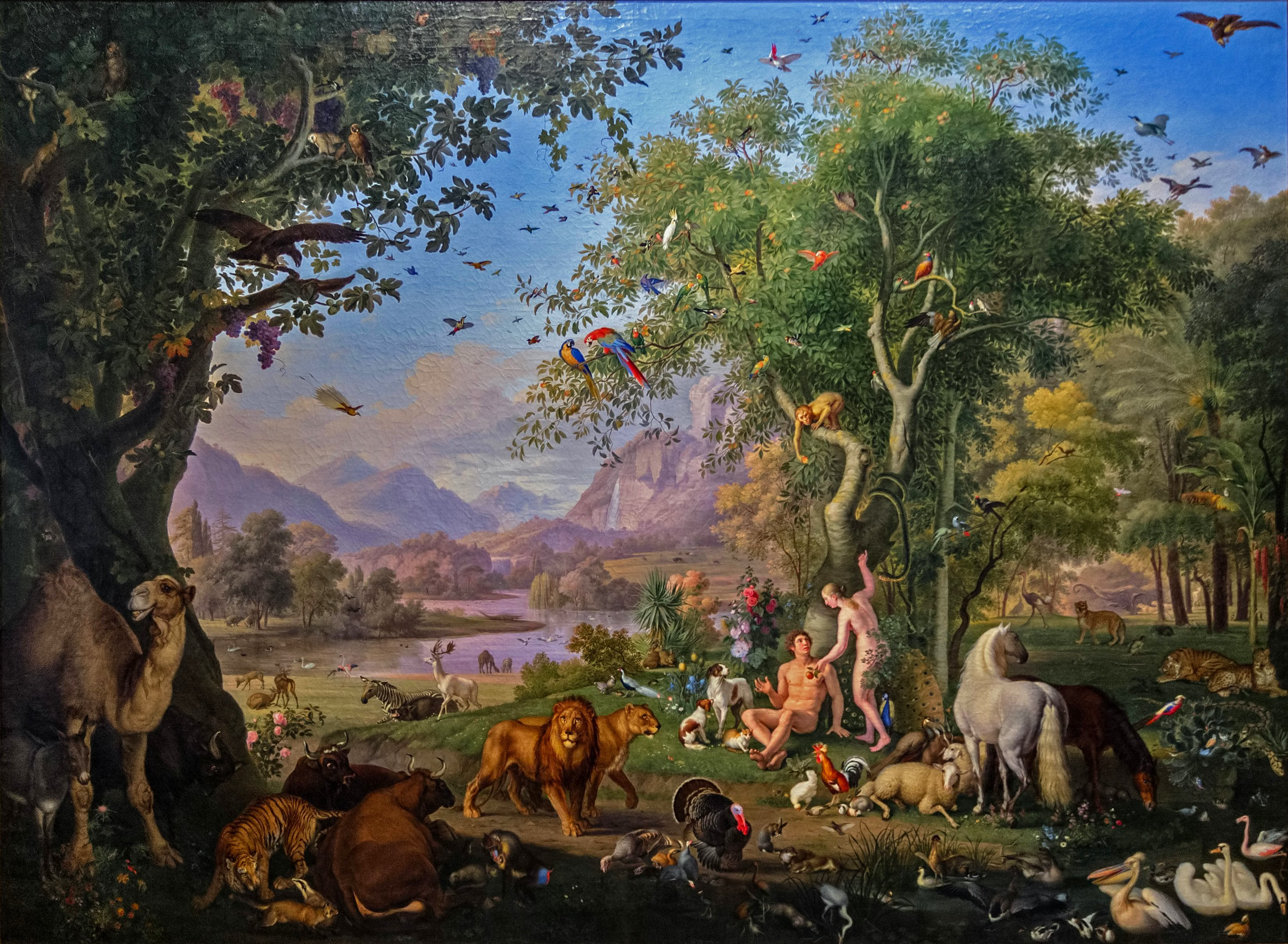
Eleven observations after reading Genesis 1–2 in the ESV, NIV(2011), and NLT.
Observation 1 –“Good” is repeated 7x throughout the creation narrative in ch.1 (cf. Gen. 1:4, 10, 12, 18, 21, 25, 31). Seems like it is God’s self-assessment of His work.
Observation 2 – Gen. 1:14–15 reveals God didn’t create an assortment of independently cool things that had no intrinsic correlation to one another. Instead, the things which He created were in accordance to His designed intention. The lights in the heavens were not just another thing He realized He could create; they were for a designed purpose that would bring an orderly rhythm to creation.
Observation 3 – The phrase “according to its/their kind(s)” occurs 10x in ch.1. It refers to vegetation broken into the categories of plants and fruit trees; sea creatures; land creatures. All of these organisms are created “according to their kinds.” Interestingly, humans are the only organism that is not created “according to its kind.” I think Gen. 2:18–25 mysteriously speaks to this.
Observation 4 – A surface reading of Gen. 2:4–9 seems to indicate that man was created before vegetation had sprouted. What is more, it seems like vegetation had not sprouted because there was not yet man to tame/tend to it. Then, God put man in the garden of Eden (cf. Gen. 2:15), which seems to imply the garden was planted.
Observation 5 – God created ex nihilo, yes, but He also continued to form that which He had previously created into something new – God made the waters and then formed them into seas; God made Adam from the ground He had already made; God made Eve from the man He had already made.
Observation 6 – Adam is translated as “mankind” in Gen. 1:27 NIV11. This fits the context of God creating “male and female.” The ESV uses the more obscure “man” (Gen. 1:27 ESV).
Observation 7 – Thus the heavens and the earth were completed in all their vast array (Gen. 2:1 NIV11)–– the description of “vast array” communicates the creative scale and scope of God’s creation. It is vast; it is interconnected; it is complicated; it is beautiful to behold.
Observation 8 – All the wild animals and birds of the sky were also formed out of the ground, not just humanity (cf. Gen. 2:19).
Observation 9 – The seeds will then produce the kinds of plants and trees from which they came (Gen. 1:11 NLT) –– The NLT’s wording emphasizes how offspring resembles the parent it comes from. The next generation of plants are not created ex nihilo. They come from the previous generation and resemble their likeness. The NLT’s translation makes that concept pop.
Observation 10 – God also blessed the sea creatures with the “be fruitful and multiply” blessing (Gen. 1:22). This is not repeated for the land animals (cf. Gen. 1:24–25). I wonder why that is?
Observation 11 – God’s creation of humans mirrors the “reproduce according to their kinds” principle that governs creation. Humans aren’t an exact replica of God, but we carry His likeness. Since we are part of creation, we then reproduce so that our children bear both the likeness of the parents and of God.
Reflecting on My Observations
What stands out to you about God?
God loves His creation. His assessment that everything is “good” means that He is satisfied with (1) His creative effort/output; (2) the creative result. Human artists are usually dissatisfied with their work to some degree, but this is not the case with God.
God didn’t create a museum of relics that are only capable of being displayed as examples of something “cool.” Instead, He wanted everything to function as the best version of itself. Everything is designed to function with purpose.
What seems true about creation?
Creation deserves to be loved, enjoyed, and cared for. Creation is designed and declared to be good. The one who is Himself the measure of goodness declares that what He has made is also good. Creation is designed to continue existing. Reproduction enables for that which exists to continue existing. In this way, God brings His creation into on-going existence with Him.
What strikes you about humans specifically?
Humans are unique within creation because we ourselves are part of creation but we are also called to manage creation. Our attitude of stewardship needs to recognized that when we care for creation, we are caring for what we were made from. Creation isn’t something external to us. We are part of it in an intimate way.
Additionally, we are the beings that are according to God’s kind. He is still unique compared to us, but humans function as the ones who come from God within creation. Our existence isn’t merely for the purpose of surviving like other organisms but also to care for where we live.


Leave a Reply