
General objectives for our word studies:
- Allow the nuances, complexities, and peculiarities of a word to lead us to a deeper theological significance than we previously had
- For the theological significance of a word / concept to help us be in awe of God, which both reinforces our faith and spurs us to more committed and faithful practice
Note: words marked with an * are listed in a “Glossary of Terms” at the end of the post.
Introduction
The Greek word ἅγιος (agios ha-GEE-os) is an important word and concept within Christianity. It is the primary Greek word for “holy” within the New Testament (NT). The term agios is also the primary word in the Septuagint (LXX)* to translate the Hebrew word קֹ֖דֶשׁ (qṓdeš, KOH-desh), which is the primary word for “holy” in the Hebrew Bible. Additionally, agios occurs 233x in the NT:
- Gospels: 42x
- Acts: 53x
- Pauline (Rom.–Phlem.): 76x
- General Epistles (Heb.–Jude): 37x
- Revelation: 25x
Fifteen of the 76 occurrences within Pauline literature occur in Ephesians. Only Romans has more occurrences of agios within Paul’s writings, but Paul uses the word agios more times per 1,000 words in Ephesians than any other letter. This indicates the concept of holiness is more important to Paul’s argument in Ephesians than it is in any of his other letters.
Why?
Why is holiness so important to Paul’s message to the Ephesian church? What does Paul mean by “holy” in his letter to the Ephesians, and how does that affect our faith and practice today?
Agios In Ephesians
The word agios occurs 15x in Ephesians:
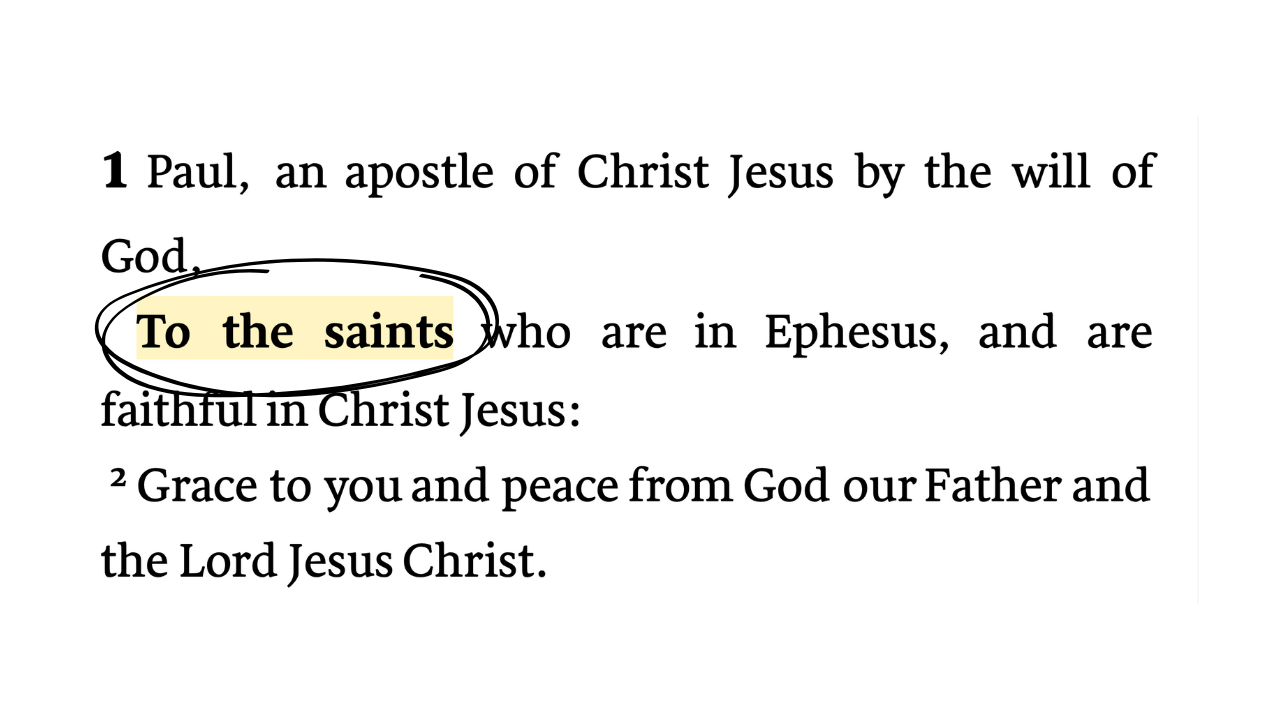
| Eph. 1:1 | Paul, an apostle of Christ Jesus by the will of God, To the saints who are in Ephesus, and are faithful in Christ Jesus: |
| Eph. 1:4 | even as he chose us in him before the foundation of the world, that we should be holy and blameless before him. In love |
| Eph. 1:13 | In him you also, when you heard the word of truth, the gospel of your salvation, and believed in him, were sealed with the promised Holy Spirit, |
| Eph. 1:15 | For this reason, because I have heard of your faith in the Lord Jesus and your love toward all the saints, |
| Eph. 1:18 | having the eyes of your hearts enlightened, that you may know what is the hope to which he has called you, what are the riches of his glorious inheritance in the saints, |
| Eph. 2:19 | So then you are no longer strangers and aliens, but you are fellow citizens with the saints and members of the household of God, |
| Eph. 2:21 | in whom the whole structure, being joined together, grows into a holy temple in the Lord. |
| Eph. 3:5 | which was not made known to the sons of men in other generations as it has now been revealed to his holy apostles and prophets by the Spirit. |
| Eph. 3:8 | To me, though I am the very least of all the saints, this grace was given, to preach to the Gentiles the unsearchable riches of Christ, |
| Eph. 3:18 | may have strength to comprehend with all the saints what is the breadth and length and height and depth, |
| Eph. 4:12 | to equip the saints for the work of ministry, for building up the body of Christ, |
| Eph. 4:30 | And do not grieve the Holy Spirit of God, by whom you were sealed for the day of redemption. |
| Eph. 5:3 | But sexual immorality and all impurity or covetousness must not even be named among you, as is proper among saints. |
| Eph. 5:27 | so that he might present the church to himself in splendor, without spot or wrinkle or any such thing, that she might be holy and without blemish. |
| Eph. 6:8 | praying at all times in the Spirit, with all prayer and supplication. To that end, keep alert with all perseverance, making supplication for all the saints, |
Words have meaning because of how they are used and relate to one another. Words are built from a basic root concept, but that root concept is only a foundation. Writers and speakers leverage words by putting them in particular contexts. A word’s meaning in ‘context A’ might differ from ‘context B’. Thus, we don’t want to project a universal meaning onto a word every time we see it. The definitions in the dictionary reflect how authors use that word. Words begin with meaning, so an author uses it in a particular way, and then the word develops a more nuanced meaning. Thus the cycle goes ‘round and ‘round.
In the case of this study, we want to know what agios means in Ephesians. This will help us understand the theological leverage Paul is placing upon it in his message to the Ephesian Church.
So, let’s analyze how agios is used throughout the letter. Throughout Ephesians, agios means:
- Saints: 9x (cf. Eph. 1:1, 15, 18; 2:19; 3:8, 18; 4:12; 5:3; 6:8)
- Adjective describing believers / individuals: 2x (cf. Eph. 1:4; 3:5)
- Adjective describing God / Spirit: 2x (cf. Eph. 1:13; 4:30)
- The Body of Christ: 2x (cf. Eph. 2:21; 5:27)
The overwhelming majority of the time, the term means “the saints,” i.e. those who believe in Christ. This may seem insignificant, but it is actually quite significant given the argument(s) of Ephesians.
To understand the theological weight of believers being called “saints,” we need to understand the historical usage of agios.
Historical Use Of Agios
The term was not very common in Greek Literature (GL)*. Throughout GL, agios developed by first referring to “the elemental forces of nature” and then morphed to mean the divine realm that exercised influence and superior power over humans.1 The adjectival form we have in the Bible (ἅγιος, agios) is not used in some of antiquity’s most notable authors, including Homer, Hesiod, or the tragedy-play writes.2 These details are significant because of they inform the cultural source from which Paul and his First Century audiences would have derived their understanding of agios– or, rather, where that cultural understanding didn’t come from. Paul was familiar with Greco-Roman philosophy and religion, but he also kept Judaism as his primary worldview and cultural anchor.3
Thus, when we combine the ambiguity and weak cultural presence within GL with Paul’s background in Judaism, we can deduce it to be more likely that Paul derived his understanding of agios from another source, and that source was Jewish Literature (JL)*.
The presence of agios within JL is in complete contrast with GL. The word agios appears over 800x in the LXX, where it primarily translates the Hebrew word-group קֹ֫דֶשׁ (qodesh). The term qodesh is the primary word for “holy” in the Hebrew Bible, and its highest concentration of occurrences is throughout YHWH’s explanation of religious practice (Exodus 25–Numbers 10). The scope of how the qodesh word-group is used throughout JL illustrates that the Jewish concept of qodesh (“holy”) included purity, and a “divine-human encounter that inevitably demands certain modes of response.”4 Judaism’s association of agios with qodesh in the centuries leading up to Paul’s birth in combination with Paul’s steeped background in Judaism (cf. Acts 22:3; 23:6; 26:4–5; Gal. 1:13–16; Phil. 3:4–5) should lead us to believe Paul derived his concept of agios from JL. In Paul’s mind, holiness required an ethical response to God. This has significant implications for Paul’s letter to the Ephesians, but will we recognize that significance in the twenty-first century?
Understanding “Saints” In Light Of Jewish Literature
As noted above, agios occurs 15x in Ephesians, and 9 of those occurrences refers to members of God’s household / followers of Jesus. When used this way, agios is often translated “the saints.”
The word “saints” is not used the same way in twenty-first century English as it qodesh / agios were used by Paul. Today, “saints” can refer to those who have been canonized by a religious tradition, but it can also refer to “virtuous person” without additional qualification as to what that virtue entails.5 Modern English readers are prone to miss the theological significance of Paul’s vocabulary if this casual understanding of “saint” is brought to the biblical text.
English readers should train themselves to associate the word “saint(s)” with the concept of holiness derived from JL. In this framework, “the saints” become the holy ones who have had a divine encounter that requires an ethical response. This understanding places much more theological weight on the 13 uses of agios in Ephesians that refer to either individuals or the corporate Body of Christ. With this framework in mind, consider again the following passages from Ephesians (agios is underlined):
- Paul, an apostle of Christ Jesus by the will of God, To the saints who are in Ephesus, and are faithful in Christ Jesus: (Eph. 1:1)
- even as he chose us in him before the foundation of the world, that we should be holy and blameless before him. In love (Eph. 1:4)
- having the eyes of your hearts enlightened, that you may know what is the hope to which he has called you, what are the riches of his glorious inheritance in the saints, (Eph. 1:18)
- So then you are no longer strangers and aliens, but you are fellow citizens with the saints and members of the household of God, (Eph. 2:19)
- in whom the whole structure, being joined together, grows into a holy temple in the Lord. (Eph. 2:21)
- But sexual immorality and all impurity or covetousness must not even be named among you, as is proper among saints. (Eph. 5:3)
Anchoring the Body of Christ’s identity as the holy ones who have had a divine encounter that requires an ethical response reveals much more theological weight to these passages, and all of Ephesians. Even though agios is only used 5x in chs. 4–6, it is these chapters that contain Paul’s imperative instructions to the Ephesians:
- Walk worthy of the calling your have received (Eph. 4:1)
- No longer walk as the Gentiles do (Eph. 4:17)
- Put on the new self (Eph. 4:24)
- And do not grieve the Holy Spirit (Eph. 4:30)
- Therefore, be imitators of God (Eph. 5:1)
- Look carefully then how you walk, not as unwise but as wise, making the best use of the time because the days are evil (Eph. 5:15–16)
- Be filled with the Spirit (Eph. 5:18)
- Be strong in the Lord and in the strength of his might (Eph. 6:10)
Conclusion
The second half of Ephesians (chs. 4–6) is full of commands for the members of God’s household, and fulfilling these commands has much more theological weight because the reason for the commands– anchored in the ethical response to God– carries intrinsic urgency and beauty. An individual’s encounter with Christ– the revelation that He is real and that He saves us for life with God– is that divine encounter embedded within the Jewish concept of qodesh. The heart posture behind our ethical response to that encounter reveals how well we understood the encounter’s implications and how precious the encounter is to us. Paul’s message to the Ephesians consistently directs their eyes and hearts up to God’s plan of redemption and the relationship between Christ and the Church. A significant part of those two concepts is that God’s people respond appropriately to the divine encounter they’ve experienced. That was Paul’s message to the Ephesians, and we need that same message today.
Glossary of Terms
Greek Literature (GL): the collection of Greek writings from the Classical era through the Roman era. This includes early writers like Homer, the philosophers Plato, Aristotle, Herodotus the historian, and the play writers. It is a vast collection of literature, consisting of multiple genres and spanning almost a millennium.6
Jewish Literature (JL): the literature produced from Jewish sources. It includes the Hebrew Bible and extra-biblical texts such as rabbinic literature, the Septuagint, the historians Philo and Josephus, and also the Dead Sea Scrolls.7
Septuagint (LXX): the Greek translation of the Hebrew Scriptures. It includes the Hebrew Bible (Protestant Old Testament) as well as other important religious texts. It is not a single document but is rather a collection of translated texts. In all, it took about 3 centuries to translate everything. Work began around 250 BC, and the LXX was in circulation by the middle of the 1st Century AD.8
Footnotes
- The New International Dictionary of New Testament Theology and Exegesis, s.v. “ἅγιος ἁγιάζω ἁγιασμός ἁγιότης ἁγιωσύνη,” 1:124. ↩︎
- The New International Dictionary of New Testament Theology and Exegesis, s.v. “ἅγιος ἁγιάζω ἁγιασμός ἁγιότης ἁγιωσύνη,” 1:124. ↩︎
- Mark J. Keown, Discovering the New Testament: An Introduction to Its Background, Theology, and Themes: The Pauline Letters, vol. II (Bellingham, WA: Lexham Press, 2021), 12. ↩︎
- The New International Dictionary of New Testament Theology and Exegesis, s.v. “ἅγιος ἁγιάζω ἁγιασμός ἁγιότης ἁγιωσύνη,” 1:125. ↩︎
- “Saint,” Merriam‑Webster.com Dictionary, Merriam‑Webster, accessed July 23, 2025, https://www.merriam-webster.com/dictionary/saint. ↩︎
- The New International Dictionary of New Testament Theology and Exegesis, s.v. “4. Linguistic data,” 1:9-11. ↩︎
- The New International Dictionary of New Testament Theology and Exegesis, s.v. “4. Linguistic data,” 1:9-11. ↩︎
- Jonathan E. Swan, “Septuagint,” in The Essential Lexham Dictionary of Church History, ed. Michael A. G. Haykin (Bellingham, WA: Lexham Press, 2022). ↩︎
Works Cited
Bauer, W., F. W. Danker, W. F. Arndt, and F. W. Gingrich, eds. A Greek-English Lexicon of the New Testament and Other Early Christian Literature. 3d, Accordance electronic ed., version 2.8. Chicago: University of Chicago Press, 2000.
Haykin, Michael A. G., ed. The Essential Lexham Dictionary of Church History. Bellingham, WA: Lexham Press, 2022.
Keown, Mark J. Discovering the New Testament: An Introduction to Its Background, Theology, and Themes: The Pauline Letters. Vol. II. Bellingham, WA: Lexham Press, 2021.
Silva, Moisés, ed. New International Dictionary of New Testament Theology and Exegesis. 5 vols. Grand Rapids, MI: Zondervan, 2014.
Leave a Reply