
Introduction
This post was my answer to the following assignment from my seminary professor:
Compare the beatitudes in Matthew to Luke. Are they saying the same thing? Include a discussion of Q in your answer and the meaning of πτωχοί (“poor”).
The assignment required us to work with the Greek text of the Beatitudes in Matthew and Luke.
What the heck is ‘Q’?
You’ll notice my professor required us to discuss “Q” in our response. Here’s what that means:
Q is the abbreviation of the German word Quelle, which means “source.” Q refers to the material that is present in both Matthew and Luke but not in Mark. Today, scholars believe Mark wrote his Gospel before Matthew and Luke. It is believed that Matthew and Luke both used Mark as a source to write their Gospels.
However, there is material within both Matthew and Luke that is not in Mark. This material makes scholars think there was another source that Matthew and Luke drew from. This hypothetical source is called “Q.”
A Convenience for the Reader
I will translate all the Greek words and phrases within my response to my professor. Also, the text of the Beatitudes in Matthew and Luke are below. I have bolded the material in common between the two.
Feel free to refer back to the text of Matthew and Luke anytime you need.
The Beatitudes in Matthew and Luke
Matthew 5:1–11
1 Seeing the crowds, he went up on the mountain, and when he sat down, his disciples came to him.
2 And he opened his mouth and taught them, saying:
3 “Blessed are the poor in spirit, for theirs is the kingdom of heaven.
4 “Blessed are those who mourn, for they shall be comforted.
5 “Blessed are the meek, for they shall inherit the earth.
6 “Blessed are those who hunger and thirst for righteousness, for they shall be satisfied.
7 “Blessed are the merciful, for they shall receive mercy.
8 “Blessed are the pure in heart, for they shall see God.
9 “Blessed are the peacemakers, for they shall be called sons of God.
10 “Blessed are those who are persecuted for righteousness’ sake, for theirs is the kingdom of heaven.
11 “Blessed are you when others revile you and persecute you and utter all kinds of evil against you falsely on my account.
12 Rejoice and be glad, for your reward is great in heaven, for so they persecuted the prophets who were before you.
Luke 6:20–26
20 And he lifted up his eyes on his disciples, and said: “Blessed are you who are poor, for yours is the kingdom of God.
21 “Blessed are you who are hungry now, for you shall be satisfied. “Blessed are you who weep now, for you shall laugh.
22 “Blessed are you when people hate you and when they exclude you and revile you and spurn your name as evil, on account of the Son of Man!
23 Rejoice in that day, and leap for joy, for behold, your reward is great in heaven; for so their fathers did to the prophets.
24 “But woe to you who are rich, for you have received your consolation.
25 “Woe to you who are full now, for you shall be hungry. “Woe to you who laugh now, for you shall mourn and weep.
26 “Woe to you, when all people speak well of you, for so their fathers did to the false prophets.
Do Matthew and Luke Mean the Same Thing When They Say πτωχοὶ (“poor”)?
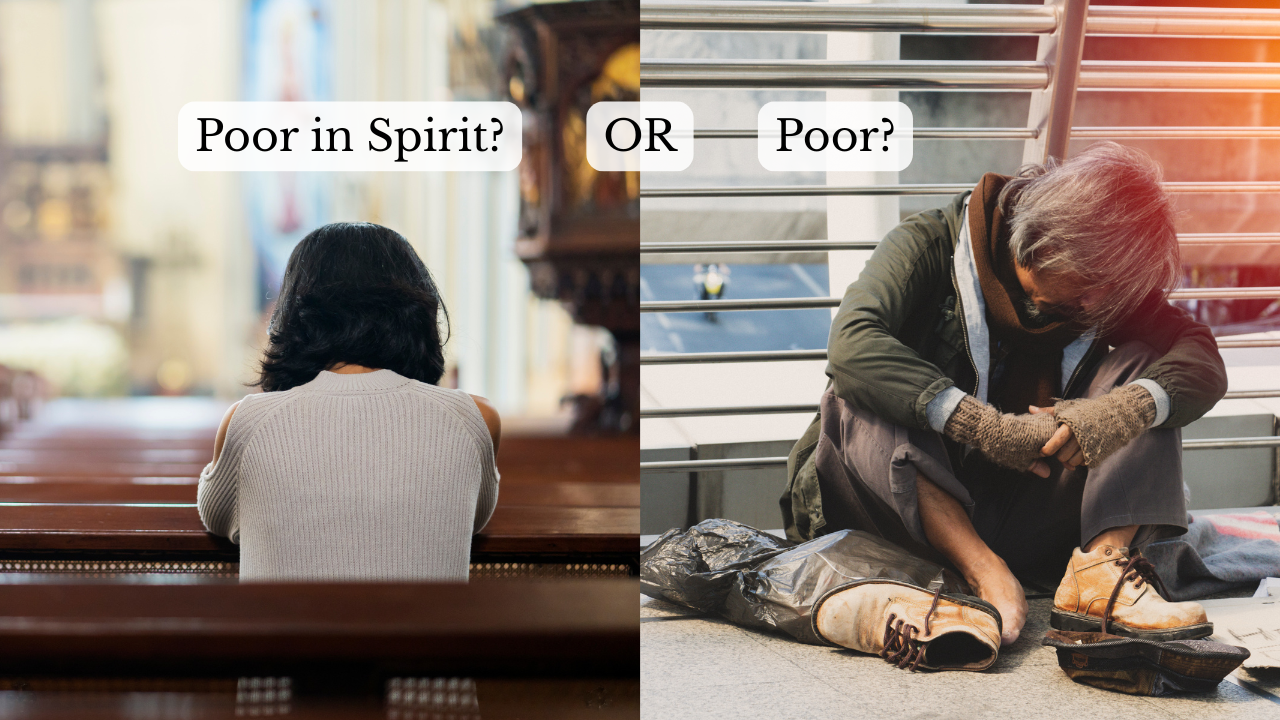
There is a lot of overlap between the Beatitudes of Matthew and Luke. Luke 6:20 only lacks the dative τῷ πνεύματι (“in spirit”) of Matt. 5:3. Both writers say “the kingdom” (“of heaven” in Matthew and “of God” in Luke) is for the poor. The following question arises: do Luke and Matthew mean the same thing when they each use πτωχοὶ (“poor”)?
One option is that Matthew makes explicit what Luke leaves implicit. Another option is that Luke is not narrowing the scope of poverty— being poor in any sense qualifies you to be part of the Lukan Beatitude. A third possibility is that Luke intentionally presents an altered / abridged version of Matthew’s account for a broader purpose. I like a combination of the latter 2 options (though my list is not exhaustive).
An interesting detail is how Luke 6:23 differs from Matt. 5:12. Matthew says “rejoice and be glad for your reward is great in heaven, for so they persecuted the prophets who were before you” (ESV), but Luke says “Rejoice in that day, and leap for joy for behold, your reward is great in heaven; for so their fathers did to the prophets” (ESV).
Luke has stronger overtones of celebration, which seems thematic for the Beatitude Q sayings. Matthew draws our attention to the condition of the individual with the crescendo being that they will participate in the suffering of the prophets before them. Luke, on the other hand, places his crescendo on the woes (vv.6:24–26).
This shift of emphasis presents a contrast between those who are blessed and those who are woe’d that reinforces the reason for celebration (if you’re among the Μακάριοι [“those who are blessed”]).
Thus, I think Luke nuances πτωχοὶ (“poor”) in a way that Matthew does not for the sake of his overall gospel proclamation. Matthew emphasizes that the kingdom of heaven is here (cf. Matt. 4:17), and his account of the Beatitudes are an implication of that proclamation.
Luke, on the other hand, lacks the Matthew 4:17 proclamation. Instead, Jesus begins his Galilean ministry by (1) teaching in the synagogues, and (2) proclaiming the reality that Isaiah 611 is fulfilled by Him (cf. Luke 4:14–21). Jesus as the good news of Isaiah 61 is the backdrop for the Lukan Beatitudes, which corresponds to the Sabbath controversies and the ministerial chaos in Luke 6:1–19 immediately before the Beatitudes. Luke’s message is to the poor now (cf. νῦν [“now”] in Lk. 6:21), the ones who need the good news of Isaiah 61.
In the end, I think Matthew and Luke are saying slightly different things, but neither one contradicts or excludes the emphasis of the other. Luke’s πτωχοὶ (“poor”) can also be Matthew’s πτωχοὶ (“poor”). Matthew’s πτωχοὶ (“poor”) are among Luke’s πτωχοὶ (“poor”).
Footnotes
- Isaiah 61 (ESV)
The Year of the Lord’s Favor
61 The Spirit of the Lord God is upon me,
because the Lord has anointed me
to bring good news to the poor;
he has sent me to bind up the brokenhearted,
to proclaim liberty to the captives,
and the opening of the prison to those who are bound;
2 to proclaim the year of the Lord’s favor,
and the day of vengeance of our God;
to comfort all who mourn;
3 to grant to those who mourn in Zion—
to give them a beautiful headdress instead of ashes,
the oil of gladness instead of mourning,
the garment of praise instead of a faint spirit;
that they may be called oaks of righteousness,
the planting of the Lord, that he may be glorified.
4 They shall build up the ancient ruins;
they shall raise up the former devastations;
they shall repair the ruined cities,
the devastations of many generations.
5 Strangers shall stand and tend your flocks;
foreigners shall be your plowmen and vinedressers;
6 but you shall be called the priests of the Lord;
they shall speak of you as the ministers of our God;
you shall eat the wealth of the nations,
and in their glory you shall boast.
7 Instead of your shame there shall be a double portion;
instead of dishonor they shall rejoice in their lot;
therefore in their land they shall possess a double portion;
they shall have everlasting joy.
8 For I the Lord love justice;
I hate robbery and wrong;
I will faithfully give them their recompense,
and I will make an everlasting covenant with them.
9 Their offspring shall be known among the nations,
and their descendants in the midst of the peoples;
all who see them shall acknowledge them,
that they are an offspring the Lord has blessed.
10 I will greatly rejoice in the Lord;
my soul shall exult in my God,
for he has clothed me with the garments of salvation;
he has covered me with the robe of righteousness,
as a bridegroom decks himself like a priest with a beautiful headdress,
and as a bride adorns herself with her jewels.
11 For as the earth brings forth its sprouts,
and as a garden causes what is sown in it to sprout up,
so the Lord God will cause righteousness and praise
to sprout up before all the nations. ↩︎
Leave a Reply